Society
Otti, Adeleke, Others Back Nationwide Drive Against Child Malnutrition

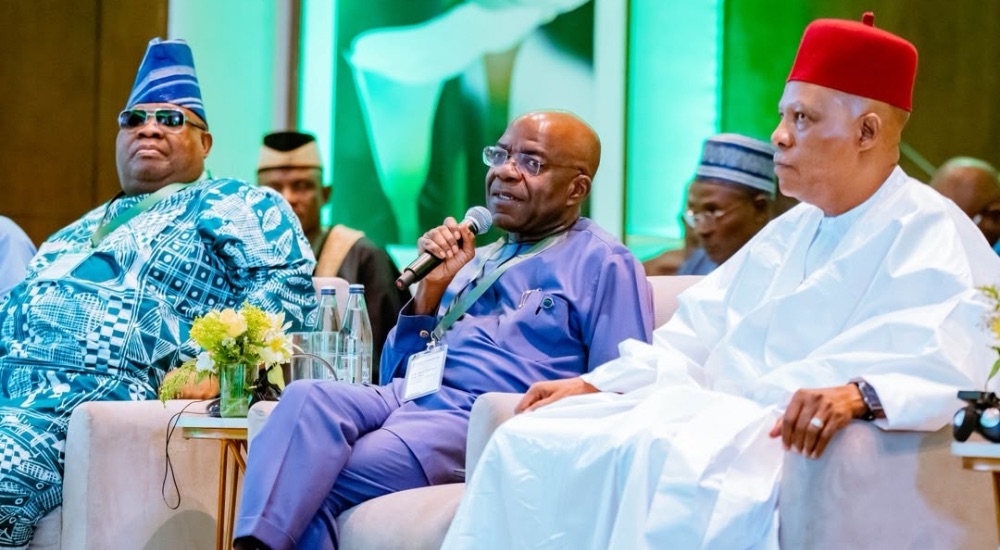
Governors Alex Otti of Abia State, Ademola Adeleke of Osun State and Dauda Lawal of Zamfara State have appealed for better coordination between federal, state and local governments to reduce child malnutrition nationwide
The governors spoke at the Nigeria–Ethiopia Nutrition Leadership Exchange held in Addis Ababa.
Vice President Kashim Shettima had led Nigeria’s delegation to Ethiopia to study the country’s experience in reducing malnutrition and child stunting through coordinated action across government institutions and local communities.
Shettima was accompanied by governors and ministers who participated in discussions on strengthening nutrition programmes under the Nutrition 774 Initiative.
The initiative is intended to extend nutrition interventions across Nigeria’s 774 local government areas, communities and households.
Governor Otti said Nigeria should learn from countries that have recorded progress in tackling malnutrition rather than trying to invent solutions.
“There’s nothing wrong with saying that we have not done as well. And there’s also nothing wrong in learning from those who have done it, so that you don’t go reinventing the wheel,” the Abia governor said.
He said efforts to improve nutrition must extend beyond food security to include healthcare, education, agriculture, climate change and poverty reduction.
“Today, we have learned that it’s not just about food security. It’s also about health. It’s about education. It’s about climate change. It’s about agriculture. So, a whole lot of things are intertwined,” he said.
On his part, Governor Adeleke said interventions should prioritise children under five and pregnant women. He noted that Nigeria had recorded some progress but needed to do more.
“Especially for the young ones under five and, of course, pregnant women, it is very, very important.
“We have some success, but we can improve on it. That is why I am here, to learn from our counterparts in Ethiopia,” he said.
Governor Lawal said insecurity had worsened nutrition challenges in Zamfara, which previously produced enough food to feed its population.
“In the past, when you spoke about nutrition, we didn’t even have anything like that in the state because we produced enough to feed our people. However, because of those challenges now, it has become difficult,” he said.
He, however, said the state would continue to pursue solutions that address its local circumstances while aligning with relevant Federal Government programmes.
“Should we be defined by the insecurity? The question is no. What else can we do?” he asked.
Jigawa State Governor Umar Namadi said Ethiopia’s experience under the Seqota Declaration could guide Nigeria’s Nutrition 774 Initiative, particularly in extending interventions to households.
According to him, the programme must reach every local government, ward and community to achieve its objectives.
“The one thing that is very important with 774 is the fact that it will have to go down from the national level to each local government, each ward, each community and each household,” Namadi said.
He said Jigawa had complemented federal interventions with local programmes, including the Masaki initiative and a nutrition programme under which about 600 women had been trained to produce Tom Brown, a nutritious food for children.
The Coordinating Minister of Health and Social Welfare, Prof. Muhammad Ali Pate, said tackling malnutrition required collaboration across government sectors and society.
“Nutrition is key to human capital development, and it requires sectors to work together in a whole-of-government and whole-of-society approach,” he said.
Pate argued that Nigeria had made progress through national interventions and community-based programmes but needed to deepen implementation.
“We have to now go back and deepen the progress, accelerate,” he said.
He disclosed that Nigeria and Ethiopia would develop a roadmap based on lessons from the exchange, expressing optimism that sustained implementation could produce significant gains within four to five years.



South-east group defends Orji Kalu over ₦14.286 billion constituency projects

Sowore Demands ₦500,000 Minimum Wage for INEC Staff

Kayode Akinmade: ₦3.5bn Ogun LG severance: When leadership meets compassion

Murder suspect slumps, dies at Bayelsa High Court

Kaduna PDP candidate condemns attack on campaign rally in Kafanchan

Singer Zlatan Ibile call out people who act ‘’stup!d” around celebrities

Court slams 14 years imprisonment on married woman for stealing newborn in Ekiti

Men share reasons for their choice in women
-

 News1 day ago
South-east group defends Orji Kalu over ₦14.286 billion constituency projects
- Breaking2 days ago
Sowore Demands ₦500,000 Minimum Wage for INEC Staff
- Breaking22 hours ago
Kayode Akinmade: ₦3.5bn Ogun LG severance: When leadership meets compassion
- Politics3 days ago
Murder suspect slumps, dies at Bayelsa High Court