News
FG directs reduction of fuel prices at NNPC stations, targets N1,350/litre

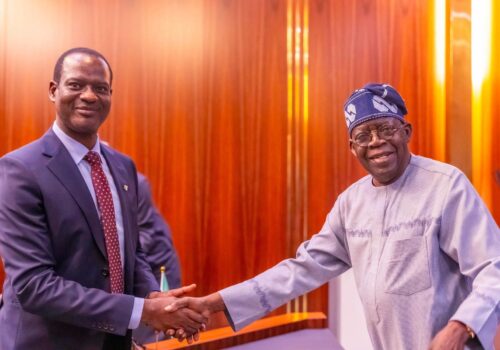
The federal government Thursday announced a 30-day plan to crash fuel prices through a discount arrangement at all filling stations operated by the Nigerian National Petroleum Company Limited (NNPCL).
The move, it said, is to provide temporary relief to households and transport operators contending with high energy and living costs.
The government, however, said the initiative should not be seen as a return to the subsidy era, pointing out that doing that would destroy the nation’s economy.
By the arrangement, the NNPC Retail, an NNPCL subsidiary, has agreed to forgo its petrol profit margin and sell at cost to ease pressure on Nigerian households, as the government negotiates a N1,350-per-litre ceiling on the landing or ex-gantry cost of the product.
The retail intervention, backed by President Bola Ahmed Tinubu, is expected to begin within the next 30 days and forms part of measures to cushion the impact of global crude oil price shocks and petrol market volatility.
Minister of Finance and Coordinating Minister of the Economy, Taiwo Oyedele, who announced this at a press conference in Abuja, said NNPC Retail would sell petrol at its cost price, with particular attention to commercial vehicles. Under the arrangement, a landing cost of N1, 300 per litre, for instance, would translate into a selling price of N1,300.
“There’ll be a discount on NNPC petrol for the next 30 days, with priority for public transporters,” Oyedele said.
…Idris on gains of reforms
Earlier in his opening address, the Minister of Information and National Orientation, Alhaji Mohammed Idris, said the results of reforms being undertaken by the Tinubu administration were visible.
“The government proposed some of the most consequential reforms for our recent history, including, of course, as we all know, the removal of fuel subsidy and other reforms.
“These reforms were necessary to address structural distortions, strengthen public finances, and redirect national resources towards critical priorities that support sustainable growth and development. Three years down the road, the results are increasingly evident.
“The economy is today on a stronger footing than it was when President Bola Ahmed took office in May of 2023. The stability that we are seeing is also possible because of the very strong foundation that was laid by the President.
“This has indeed created enough fiscal capital for investment to happen and for enterprises to also flourish in our country,” Idris said.
According to him, as President Tinubu announced in his Independence Day broadcast, there is a transition from reform to prosperity.
“The focus now is on impact, ensuring that the gains of this reform are felt on the dining tables of each member, each Nigerian, and everyone living in this country.
“It is also to provide a strong footing for businesses to thrive and for every Nigerian to have lower cost of living and indeed improved quality of life,” he said.
Idris further said, “Our goal, the goal of the President, is to ensure an economy that is increasingly driven by production, investment, and by enterprise.
“Where progress is made not only by economic indicators, but by opportunities available to our young people. The strength of our businesses, the productivity of our farms, our industries, and the understanding of Nigerians and Nigerians.”
…Oyedele speaks further
Speaking further, Oyedele expressed the hope that other marketers would follow NNPC’s example, saying the sharp increase in crude oil and petrol prices was not expected to persist.
He stressed that the company’s decision to surrender its retail margin should not be interpreted as a return to subsidy.
Beyond the retail intervention, the minister said the government was negotiating a mechanism to keep petrol landing or ex-gantry costs within a ₦1,350-per-litre ceiling.
“The proposed ceiling applies to supply costs rather than the final price motorists pay at filling stations.
“Where costs exceed the ceiling, refiners and importers would absorb the difference and recover it subsequently when crude prices or exchange-rate movements permit, without breaching the ceiling.
“This is neither a subsidy nor a price control: it is designed to smooth prices over time rather than suppressing them,” Oyedele said.
He explained that stable prices would reduce uncertainty for households and businesses, particularly because transport fares often rise quickly following fuel price increases but fall more slowly when costs decline.
The ceiling, he added, would be reviewed monthly, adjusted as costs require and published to ensure transparency.
Oyedele also announced forward sales of crude oil to domestic refineries, saying increased production and the release of previously committed crude were expected to help shield pump prices from international market volatility.
“To address transport and distribution costs, the government would work with states and security agencies to curb road taxes and levies that inflate fares and logistics expenses, under the 2025 tax reform laws.
“Funding for cash transfers to the most vulnerable households would also increase, alongside subsidised credit for small businesses and consumers,” he said.
The government said it was accelerating the deployment of compressed natural gas in collaboration with states, describing CNG as 60–70 per cent cheaper than petrol.
“Transport operators benefiting from the programme would be expected to pass savings on to passengers through lower fares.
…Other measures
An excess profit tax would also be considered for operators taking undue advantage of consumers across the energy value chain,” Oyedele added.
According to him, proceeds from taxes on price gouging would be used exclusively for transport support or vouchers for urban minimum-wage earners identified as particularly vulnerable to rising fuel costs.
The executive would further engage the National Assembly on enhanced tax relief for low-income earners under the proposed 2027 Finance Bill.
Other interventions include reducing regulatory costs that feed into business expenses and consumer prices, improving traffic flow in major urban centres to cut fuel consumption, and using NIPOST’s newly launched address codes to improve logistics efficiency.
The government also announced investment in a National Strategic Fuel Reserve to protect households and businesses against future supply disruptions.
Refined products from the reserve would be released under published rules whenever global disruptions or hoarding threaten supply and price stability. The Presidency said the arrangement would discourage artificial scarcity and market manipulation without fixing prices.
Acknowledging the hardship associated with high fuel costs, he said restoring a blanket subsidy would expose the country to renewed scarcity, smuggling, currency pressure and fiscal difficulties.
“Removing the fuel subsidy came at a price. But the alternative has been tried,” he said.
The minister added that the government’s priority was to make the benefits of reform reach more Nigerians faster, while developing a comprehensive package of fiscal measures aimed at bringing inflation sustainably into single digits in the near term.
…Reason for current pump prices
Speaking further, Oyedele said returning the county to the fuel subsidy era would weaken the naira to nearly N3,000 to the dollar and push petrol above N2,000 a litre, blaming the current pump prices on the Gulf conflict, not on subsidy removal.
He said: “Prices have risen, and Nigerians are feeling it. That concern is legitimate, and this government recognises it. But where we differ is on the remedy.
“Removing the subsidy came at a price and many households are still bearing it. But the alternative has been tried. Nigeria has already lived through the cycle of scarcity, smuggling, a collapsing currency, and a fiscal crisis.
“We cannot afford to live through it again. Least of all, the response to the temporary disruption and, at the very moment, the result of reforms are gathering pace. Our task is not to reverse the necessary reform designed to set our country on the path towards sustained prosperity.
“It is to make sure it can reach more Nigerians more quickly and in more tangible ways. That is the work before us and that is the work we are committed to doing under the leadership of His Excellency, President Bola Ahmed Tinubu.”
…Global shock
Oyedele said the pressure began “far from our shores, in the Gulf, a conflict now in its eighth month. By mid-September, shipping through the Strait of Hormuz was running at roughly 13 percent of its pre-war level, while Brent crude traded above $100 a barrel, almost 50 percent higher than before the war.
“Before the conflict, with crude near $70, petrol sold for about N830 a litre. It now averages about N1, 400. That increase was caused by a global conflict in which we had no say. Ironically, without the removal of subsidy, the impact would have been far greater.
“Fuel has remained available in every state. In a crisis of this kind, availability is the first form of affordability.”
…Refiners thriving
Oyedele credited deregulation for keeping supply steady. “Deregulation made domestic refining viable. That is why supply has held while other countries scramble for scarce cargoes.”
He added that local refiners now buy Nigerian crude in naira, which “eases demand for dollars and keeps the transaction transparent and less exposed to volatility.”
…Why subsidy would backfire
He further spoke on the reasons Nigeria can’t afford a return to era of fuel subsidy.
“Pump prices follow the exchange rate. Returning to subsidy would mean subsidising foreign exchange, which he said is “the multiple exchange rate system that brought the economy close to a collapse” before 2023.
On the idea of a “production subsidy” for local refining, he said, “A true production subsidy supports a producer who cannot compete at market prices. This is different, it is a discount on crude, passed through to the pump. That is a consumption subsidy by another route, with the same bill attached.”
Subsidy hides volatility; it does not remove it. Nigeria consumes roughly 50 million litres of petrol a day, and returning to the pre-reform price would cost more than 20 trillion naira a year. Even N500 a litre, which some have promised, would cost over 16 trillion naira a year.”
He warned that discounted fuel would leak across borders, with “Nigerian taxpayers subsidising motorists across our borders, as we did for years.”
Oyedele added that subsidy removal released N15.8 trillion to the Federation Account between June 2023 and December 2025, of which N10.4 trillion went to states and local governments.
“In May 2023, 27 states could not reliably pay salaries. Today, none is in that position,” he said.
Reversal, he warned, would invite a sovereign credit downgrade, and “borrowing becomes costlier. Capital leaves. Reserves fall. The naira weakens.”
He estimated the exchange rate “could approach 3,000 naira to the dollar within months.”
“A subsidy does not lower the cost of fuel. It only changes how it is paid, and when,” he said, adding that “short-term relief bought with long-term fragility is the most expensive money a government can spend.”
He said full tax and duty waivers on petrol were worth over N3.3 trillion for the year to 30 September 2026 and save consumers between N400 and N600 a litre.
According to him, “Nigerian petrol is 20 to 30 percent cheaper than in Benin, Togo and Cameroon, roughly 35 percent below the world average.”



South-east group defends Orji Kalu over ₦14.286 billion constituency projects

Sowore Demands ₦500,000 Minimum Wage for INEC Staff

Kayode Akinmade: ₦3.5bn Ogun LG severance: When leadership meets compassion

Murder suspect slumps, dies at Bayelsa High Court

Kaduna PDP candidate condemns attack on campaign rally in Kafanchan

Kano govt orders immediate exit of civil servants who have reached retirement age

Umahi to Nigerians: Acknowledge Tinubu’s infrastructure projects

Mom influencer k!lls her partner and three kids in murd£r-su!cide hours after ominous final post
-

 News1 day ago
South-east group defends Orji Kalu over ₦14.286 billion constituency projects
- Breaking2 days ago
Sowore Demands ₦500,000 Minimum Wage for INEC Staff
- Breaking1 day ago
Kayode Akinmade: ₦3.5bn Ogun LG severance: When leadership meets compassion
- Politics3 days ago
Murder suspect slumps, dies at Bayelsa High Court