News
VP Shettima seeks diaspora support for Tinubu’s Renewed Hope Agenda



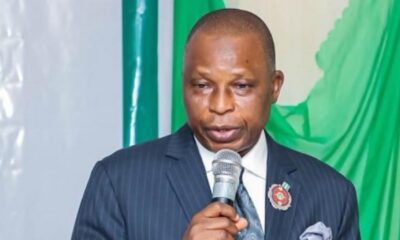
Vice President Kashim Shettima has called on Nigerians living abroad, particularly those in the United States, to support the administration of President Bola Ahmed Tinubu in its efforts to transform the Nigerian economy and reposition the country for sustainable growth.
Shettima made the call on Wednesday during an interactive session with members of the Nigerian diaspora community in the United States at the Nigeria House in New York.
The meeting was organised and coordinated by the Chairman/Chief Executive Officer of the Nigerians in Diaspora Commission (NiDCOM), Hon. Abike Dabiri-Erewa. Blueprint reports
The Vice President is in New York as President Tinubu’s representative at the 81st United Nations General Assembly.
Diaspora intellect critical to Nigeria’s future
The Vice President described Nigerians in the diaspora as an important reservoir of knowledge, expertise and human capital that could contribute significantly to national development.
He said the Federal Government was working to reposition key sectors, including education, healthcare, science and technology and agriculture, while seeking to harness the expertise of Nigerians abroad.
According to Shettima, the intellectual capacity of Nigerians at home and abroad remains central to the country’s ability to unlock its enormous potential.
“Citizens of our country have the capacity and intellect to harness our nation’s potentials and take it to greater heights,” he said.
He therefore, urged Nigerians in the United States to remain connected to the country and contribute to the ongoing efforts to build a stronger economy and more effective institutions.
Shettima defends Tinubu’s reform programme
Speaking on the economic reforms introduced by the administration, Shettima said President Tinubu had demonstrated political courage by taking what he described as difficult decisions aimed at addressing structural challenges in the economy.
He said the President, upon assuming office, chose to focus on policy decisions rather than blaming his predecessor for the condition of the country.
“When President Tinubu assumed office, he did not resort to trading blames and accusing his predecessor for the state of affairs of our nation. Rather, he took decisions that only a leader of courage and conviction would take,” the Vice President said.
Shettima maintained that the administration’s reforms were beginning to produce measurable outcomes, citing developments in foreign reserves, economic growth and the foreign exchange market.
He said the reforms had contributed to an increase in Nigeria’s foreign reserves from about $3.9 billion to more than $55 billion, while also pointing to a 4.45 per cent growth recorded in the latest quarter referenced by the administration.
Diaspora remittances, investment
The Vice President also linked improvements in the foreign exchange market and reserves to the interests of Nigerians living abroad, particularly in relation to remittances and investments.
He said greater stability in the foreign exchange market would help provide a more predictable environment for Nigerians sending money home or investing in businesses and other ventures in the country.
The administration, he added, was working to strengthen investor confidence and create conditions that would encourage Nigerians in the diaspora to participate more actively in the domestic economy.
Shettima further cited the Dangote Refinery as an example of large-scale private-sector investment and industrial development taking place in Nigeria.
“We are working day and night to reposition the Nigerian nation as investment confidence is returning to Nigeria, and the Dangote Refinery success story is a true manifestation in recent times,” he said.
He also assured the diaspora community that Nigeria remained open to business and investment, urging them to look beyond negative narratives about the country, particularly those circulating on social media.
NELFUND supports over 1.29m students
The Vice President also highlighted the administration’s intervention in the education sector, particularly through the Nigeria Education Loan Fund (NELFUND).
According to him, more than 1.29 million Nigerian students in tertiary institutions have accessed about N125 billion since the programme began.
The initiative, he said, forms part of the administration’s broader effort to improve access to higher education and reduce financial barriers confronting students and their families.
Shettima said the Federal Government was also paying attention to other sectors considered critical to Nigeria’s long-term development, including healthcare, agriculture, science and technology.
VP addresses security challenges
On insecurity, Shettima acknowledged that Nigeria continued to face security challenges but said the problem was not peculiar to the country.
He assured Nigerians that the Federal Government was deploying available resources and security mechanisms to contain emerging threats and strengthen national security.
He also appealed for greater unity among Nigerians, stressing that the country’s diversity should not become a source of division.
The Vice President urged citizens to place national interest above sectional considerations, noting that collective efforts remained necessary to achieve a peaceful and prosperous Nigeria.
“Whatever binds us together supersedes whatever divides us as a people,” he said.
Governors, ministers attend meeting
The meeting was attended by several state governors, including Babagana Zulum of Borno State, Abdulrahman AbdulRazaq of Kwara, Siminalayi Fubara of Rivers and Dauda Lawal of Zamfara.
The Senate Leader, Senator Opeyemi Bamidele, was also present, alongside spouses of the governors of Kwara, Katsina, Abia and Osun states.
Members of the Federal Executive Council at the meeting included the Minister of Foreign Affairs, Ambassador Bianca Odumegwu-Ojukwu; Minister of Science, Innovation and Technology, Dr Kingsley Tochukwu Udeh; Minister of Humanitarian Affairs and Poverty Reduction, Dr Bernard Doro; Minister of Education, Dr Tunji Alausa; and Minister of Solid Minerals Development, Chief Dele Alake.
Others were the Minister of Women Affairs, Hajiya Imaan Sulaiman-Ibrahim; Minister of State for Budget and Economic Planning, Dr Doris Uzoka-Anite; Minister of State for the FCT, Dr Mariya Bunkure; Nigeria’s Permanent Representative to the United Nations, Ambassador Jimoh Ibrahim; and Nigeria’s Ambassador to the United States, Ambassador Kayode Are.
Heads of government agencies and senior officials of Nigeria’s diplomatic mission in the United States also attended the engagement.
The meeting provided an opportunity for the Federal Government to engage directly with Nigerians abroad on the country’s economic direction, investment opportunities and ongoing reforms, while also seeking stronger participation from the diaspora in Nigeria’s development.



AGF Urges Court to Throw Out El-Rufai’s ₦1bn Rights Suit

âThe money was for the artistesâ â Peter Okoye admits receiving about $800k in royalties, says Jude got nothing

Naira faces fresh pressure due to strong dollar, fuel costs

AFC supports ₦729 billion series 2 bonds to advance Nigeria’s power sector reforms
âHe is fine. Most of the girls are lying and bitter because he didnât end up with themâ â Audrey Cyrilâs fiancéâs brother speaks on infidelity saga

Court adjourns El-Rufai’s N1 billion rights suit against ICPC, others
âIf I were Audrey, I would go ahead with the wedding as long as heâs not g@yâ â Actress Sarah Martins

100-year-old woman, 60 others memorise Qur’an in Kano
-

 Breaking3 days ago
AGF Urges Court to Throw Out El-Rufai’s ₦1bn Rights Suit
- Special Reports2 days ago
âThe money was for the artistesâ â Peter Okoye admits receiving about $800k in royalties, says Jude got nothing
- News3 days ago
Naira faces fresh pressure due to strong dollar, fuel costs
- News14 hours ago
AFC supports ₦729 billion series 2 bonds to advance Nigeria’s power sector reforms