News
Nigeria at 66: FG consolidating gains of economic reforms to benefit all Nigerians – Akume, Idris


…Reforms designed to build larger, inclusive economy – Bagudu
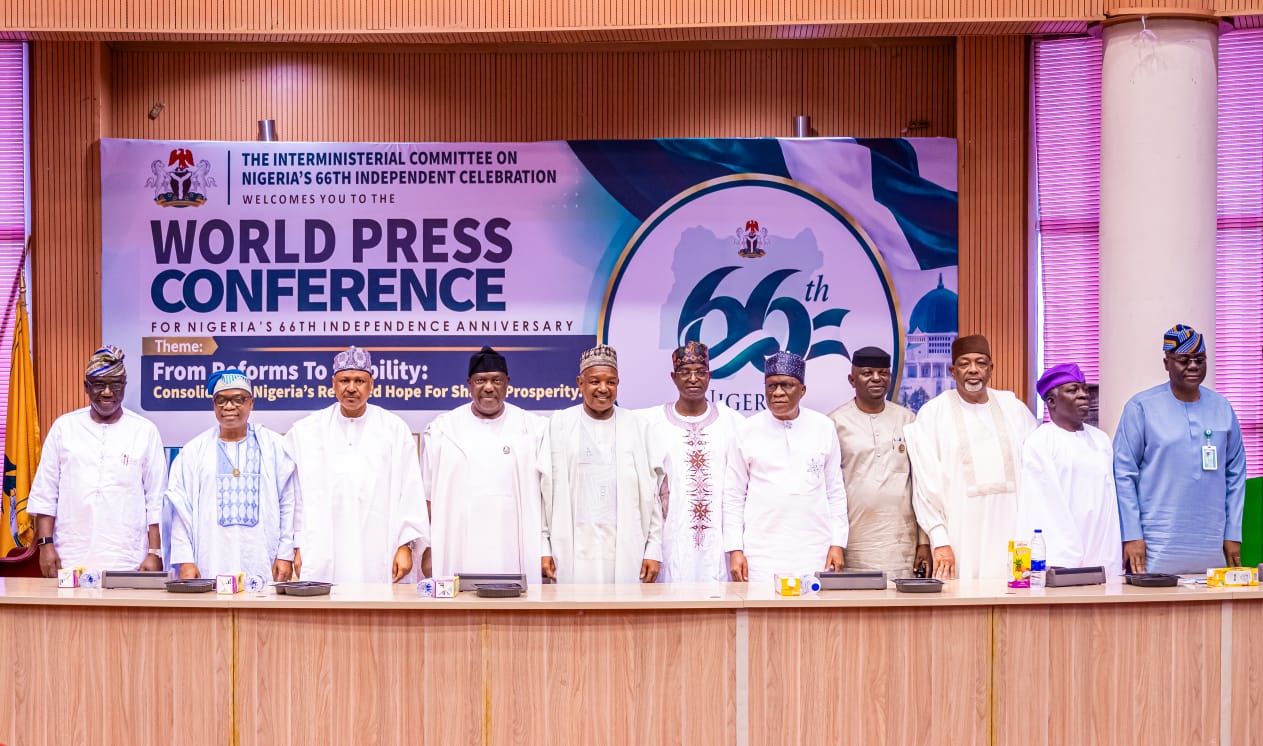
The federal government Thursday said it is consolidating on the gains of reforms being undertaken by the administration of President Bola Ahmed Tinubu under the Renewed Hope Agenda to ensure that it benefits the majority of Nigerians.
The Secretary to the Government of the Federation (SGF), Senator George Akume, stated this at a world press conference as part of activities to mark Nigeria’s 66th independence anniversary in Abuja.
He said, “The task before us today, as leaders and citizens, is consolidation.
“We must ensure that the gains from reform translate into better opportunities for ordinary Nigerians.”
Akume, said Nigeria’s 66-year journey had recorded significant milestones, including uninterrupted constitutional democracy since 1999.
He disclosed that the Federal Government is mobilising revenue, improving public finances and implementing interventions across infrastructure, agriculture, education, health and social protection, while emphasising the need to protect vulnerable Nigerians.
“The guiding principle is that while we reform our economy, we must protect those who are already struggling. No one in poverty should be forgotten,” he said.
The SGF said the Administration would continue strengthening security, supporting the private sector and promoting national cohesion to ensure that economic opportunities reach communities across the country.
“From reforms, we have built stability. From stability, let us deepen growth and opportunity, and from growth, let us extend shared prosperity to every corner of Nigeria,” Akume said.
The SGF said to that end, the government is actively mobilising additional revenues and improving public finances to create fiscal space that benefits all Nigerians.
“We are accelerating non-oil revenue collection and attracting new investment. We have set up a new economic council chaired by the vice president to advise on macroeconomic strategy and coordinate across federal and state governments, every step is geared towards turning stability into growth and growth into prosperity for all,” he said.
Speaking further, the SGF said infrastructure is a key priority in this phase.
He noted that the federal government is investing in transportation, roads, railways, airports, seaports, energy, electricity generation, transmission and distribution, and digital connectivity.
He said, “The government is supporting farmers with improved seeds, fertilizers, irrigation, and better storage and processing facilities.
“We have established the National Cultural Development Fund and attracted international funding.
“By building roads and empowering farms, we lift entire communities.”
He said the government is expanding access to education at all levels and improving the quality of schools and teachers.
“In May 2024, the government signed the Nigerian Education Loan Fund Act, creating a student loan program to help more young Nigerians have access to tertiary education.
“In health, we’re working to strengthen hospitals and clinics, and to combat diseases that hold back our productivity.
“At the same time, social protection programs continue to assist the most vulnerable,” he said.
He further said initiatives such as the conditional cash transfer, school feeding, and vocational training schemes have been expanded.
“These programs target women, youth, people with disabilities, and others who need support, ensuring they are not left behind during tough economic adjustment.
” This government deliberately reaches out to those who are left out. The guiding principle is that while we reform our economy, we must protect those who are already struggling. No one in poverty should be forgotten, and we build the foundation for greater prosperity,” he said.
Akume however, admitted that security is a major challenge in parts of the country, adding that terrorism, banditry, kidnapping, and other violence have cost lives and disrupted livelihoods.
He however, said “through the sacrifices and commitment of our gallant fighting soldiers and security agencies. The escalation in insecurity is being gradually extinguished.”
Idris
Earlier in his remarks, the minister of information and national orientation Alhaji Mohammed Idris, also reaffirmed the commitment of the federal government to consolidating the reforms of Tinubu’s administration and translating emerging economic gains into improved living standards for Nigerians.
Idris said the anniversary was an opportunity to reflect on Nigeria’s journey, recognise the resilience of its people and renew commitment to building a more prosperous, secure and united country.
“Independence Day occupies a special place in our national life. It reminds us of the sacrifices that brought us here, the resilience that has sustained us, and the responsibility every generation carries to strengthen the country it inherited,” he said.
The Minister said President Tinubu inherited significant structural and fiscal challenges but chose to confront longstanding distortions, despite the difficult adjustments involved.
“Those decisions were difficult, and Nigerians have borne real costs. Today, however, Nigeria is moving from the difficult work of reform and stabilisation towards a new phase of growth, production and shared prosperity,” Idris said.
He said Nigeria’s real GDP grew by 4.43 per cent in Q2 2026, up from 4.23 per cent in Q2 2025, while foreign reserves, domestic refining capacity, investment and productive activity strengthened. He also cited Nigeria’s delisting from the FATF Grey List and return to the JP Morgan Emerging Markets Bond Index after 11 years. “Our external position has strengthened, foreign reserves have risen, domestic refining capacity has expanded, and investment and productive activity are gaining momentum,” he said.
Idris said there was progress to acknowledge, challenges to overcome and more work ahead, with the ultimate responsibility being to leave future generations a stronger country. “Our responsibility is to hand the next generation a Nigeria that is more prosperous, more secure, more united and more confident than the one we inherited,” he said.
On security, Idris acknowledged that challenges remained but said the Federal Government had strengthened security operations through increased investment in equipment, intelligence, personnel and inter-agency coordination. “Now, does it mean that we have solved all the security challenges in this country? No, and there is so much progress,” he said.
Bagudu
Responding to questions from journalists, the Minister of Budget and Economic Planning, Senator Abubakar Atiku Bagudu, said the reforms were designed to make deliberate policy choices that would build a larger and more inclusive economy.
“We are not yet where we want to be. What is important is to identify what are the choices that we need to make so that we can go to where we want to be,” Bagudu said.
Kyari
The Minister of Agriculture and Food Security, Senator Abubakar Kyari, said improved access to farmlands in previously affected areas, alongside government support for fertiliser and improved seeds, was contributing to increased agricultural production.
“We have seen a lot of areas in the centre; 70 per cent of those places that were hitherto under security have been liberated. We have seen an increase in production today,” Kyari said.



AGF Urges Court to Throw Out El-Rufai’s ₦1bn Rights Suit

âThe money was for the artistesâ â Peter Okoye admits receiving about $800k in royalties, says Jude got nothing

Naira faces fresh pressure due to strong dollar, fuel costs

‘Don’t hire mobs, buy votes’ – IGP Disu warns politicians ahead 2027 elections

AFC supports ₦729 billion series 2 bonds to advance Nigeria’s power sector reforms
âHe is fine. Most of the girls are lying and bitter because he didnât end up with themâ â Audrey Cyrilâs fiancéâs brother speaks on infidelity saga

Court adjourns El-Rufai’s N1 billion rights suit against ICPC, others

100-year-old woman, 60 others memorise Qur’an in Kano
-

 Breaking2 days ago
AGF Urges Court to Throw Out El-Rufai’s ₦1bn Rights Suit
- Special Reports2 days ago
âThe money was for the artistesâ â Peter Okoye admits receiving about $800k in royalties, says Jude got nothing
- News3 days ago
Naira faces fresh pressure due to strong dollar, fuel costs
- Politics3 days ago
‘Don’t hire mobs, buy votes’ – IGP Disu warns politicians ahead 2027 elections