News
NAF aircraft makes emergency landing, raises fresh safety concerns few days after Ondo crash

Barely 48 hours after a Nigerian Air Force (NAF) ATR-42 aircraft crashed in Ondo state, killing all 25 people on board, another NAF aircraft was forced to make an emergency landing in Benue state, in an incident that has renewed attention on the safety of military aviation operations in the country.
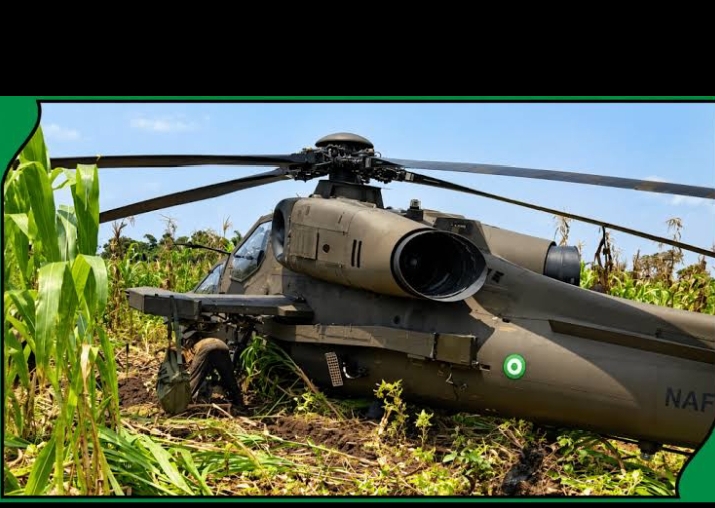
The helicopter reportedly made the precautionary landing on farmland in the Utur Tse-Igboji area of Makurdi, along the Welfare Quarters-Mopol 13 Ring Road corridor, after developing a technical fault while in flight. Blueprint reports
Unlike the Ondo disaster, however, the Benue incident ended without loss of life, with eyewitnesses reporting that the crew successfully guided the helicopter onto an open field and all personnel on board escaped unhurt.
The incident occurred on Wednesday, October 7, 2026 less than two days after NAF 931, an ATR-42 aircraft, crashed in the Igbokoda area of Ilaje Local Government Area (LGA) of Ondo state during a routine mission from Benin City to Lagos.
The Ondo crash claimed the lives of 25 people comprising five crew members and 20 passengers, according to the NAF, which subsequently released the names of all those on board.
Benue landing averts another tragedy
The latest incident occurred when the helicopter reportedly encountered a technical problem during flight, forcing the crew to look for a suitable area for an emergency landing.
Eyewitnesses said the aircraft was successfully manoeuvred onto farmland in the Makurdi area, allowing those on board to leave the aircraft safely.
A resident, Stephen Ikpam, who witnessed the incident, reportedly expressed relief that the crew survived after what could have developed into another serious aviation accident.
Residents subsequently gathered around the area to offer assistance, while military security personnel arrived to secure the scene and facilitate further assessment of the aircraft.
The nature of the technical fault and the circumstances surrounding the incident will, however, need to be established by the appropriate military authorities.
That distinction is important, particularly because the cause of the much more serious Ondo crash has not yet been established.
Coming after Ondo tragedy
The timing of the Benue incident has inevitably attracted heightened attention because of the tragedy that occurred in Ondo only two days earlier.
On October 5, NAF 931, an ATR-42 aircraft, crashed in the Igbokoda area while on a routine flight from Benin City to Lagos.
The Nigerian Air Force initially activated search-and-rescue operations before confirming that there were no survivors.
The aircraft had five crew members and 20 passengers on board, according to the revised official manifest released by the Air Force.
The crash prompted President Bola Tinubu to declare three days of national mourning and direct that a thorough investigation be conducted to determine what caused the accident and prevent a recurrence.
The Chief of the Air Staff, Air Marshal Sunday Kelvin Aneke, also described the loss as a painful moment for the Air Force and the country.
With the investigation into the Ondo accident still ongoing, the Benue emergency landing has added another aviation incident to the immediate national conversation around the safety and reliability of military aircraft.
There is, however, no evidence at this stage linking the two incidents or establishing that they resulted from the same technical or operational problem.
NAF has recorded both fatal and non-fatal incidents
The latest events also bring back memories of a number of previous NAF aircraft incidents in which the outcomes varied considerably.
In December 2025, an NAF Alpha Jet developed an in-flight emergency shortly after taking off from NAF Base Kainji during a post-inspection functional check flight.
The two pilots successfully manoeuvred the aircraft away from populated areas before ejecting safely.
The NAF subsequently said the pilots displayed exceptional courage and professionalism, while the Chief of the Air Staff ordered a Board of Inquiry into the incident.
That incident demonstrated how decisive action by an aircrew can prevent an emergency from turning into a major disaster.
The December incident is particularly relevant to the Benue case because both involved aircraft emergencies in which the crews were able to respond before the situation resulted in fatalities.
Previous crashes raised similar safety questions
The NAF has also experienced more serious accidents in recent years.
On August 14, 2023, an MI-171 helicopter on a casualty evacuation mission crashed near Chukuba village in Shiroro Local Government Area of Niger State.
The helicopter had departed Zungeru Primary School for Kaduna before it was discovered to have crashed. The NAF later confirmed that the accident killed the passengers and four NAF crew members on board.
Earlier that same year, on July 14, an FT-7NI trainer aircraft crashed in Makurdi during a routine training exercise.
The two pilots on board survived after successfully ejecting from the aircraft, and the NAF constituted a Board of Inquiry to establish the immediate and remote causes of the accident.
The recurrence of incidents involving different categories of NAF aircraft — from helicopters and trainer jets to transport and surveillance aircraft — underscores the importance of maintenance, technical inspections, pilot training and robust accident-prevention systems.
Abuja crash killed seven in 2021
One of the more significant recent NAF accidents occurred in February 2021, when a Beechcraft KingAir B350i, NAF 201, crashed while returning to Abuja after reporting an engine failure on a surveillance mission to Minna.
All seven personnel on board died.
The NAF said an investigative panel was instituted to determine the immediate and remote causes of the accident.
Three months later, another NAF aircraft crash in Kaduna claimed 11 lives, including the then Chief of Army Staff, Lieutenant General Ibrahim Attahiru.
The Beechcraft 350 aircraft crashed near Kaduna International Airport on May 21, 2021. The Defence Headquarters subsequently attributed the accident to bad weather.
These incidents remain part of the broader history of military aviation accidents in Nigeria and explain why every new aircraft emergency attracts considerable public attention.
Need for lessons from every incident
While military aviation involves inherent risks, particularly given the demanding nature of counter-insurgency, surveillance, casualty evacuation and other operational missions, each accident or emergency presents an opportunity to strengthen safety procedures.
The NAF itself acknowledged in 2023, following the Niger State helicopter crash, that increased air operations bring additional operational challenges and that investigations are necessary to determine the causes of mishaps.
The key issue following the latest incidents, therefore, will be what investigators establish and what corrective measures are subsequently implemented.
For the Ondo crash, the immediate priority remains determining why NAF 931 went down and whether mechanical failure, human factors, weather, operational circumstances or another factor played a role.
For the Benue helicopter, investigators and technical teams will similarly need to establish the nature and source of the reported technical fault before the aircraft is returned to service.
From tragedy to lessons
The contrast between the two incidents could hardly be sharper.
In Ondo, 25 people lost their lives after an NAF aircraft crashed during a routine mission. In Benue, an aircraft reportedly developed a technical problem but its crew successfully brought it down in an open area without fatalities.
Both incidents nonetheless underline the importance of aircraft readiness, technical maintenance, crew preparedness and effective emergency-response systems.
The safe outcome in Benue also demonstrates the value of proper training and quick decision-making when an aircraft develops a problem in flight.
For the families of those lost in Ondo, however, the latest incident will inevitably reinforce calls for answers.
As the investigations continue, attention will now be on the Nigerian Air Force and other relevant authorities to establish the facts surrounding the Ondo disaster, determine what caused the Benue emergency and ensure that lessons from both incidents are translated into stronger aviation safety measures.
The objective, ultimately, is not merely to explain why an aircraft was forced to land or why another crashed, but to ensure that every investigation produces practical measures capable of preventing the next tragedy.



Sowore Demands ₦500,000 Minimum Wage for INEC Staff

South-east group defends Orji Kalu over ₦14.286 billion constituency projects

Kayode Akinmade: ₦3.5bn Ogun LG severance: When leadership meets compassion

Murder suspect slumps, dies at Bayelsa High Court

Kaduna PDP candidate condemns attack on campaign rally in Kafanchan

Man found dead in Plateau

Kano govt orders immediate exit of civil servants who have reached retirement age

Umahi to Nigerians: Acknowledge Tinubu’s infrastructure projects
-

 Breaking2 days ago
Sowore Demands ₦500,000 Minimum Wage for INEC Staff
- News1 day ago
South-east group defends Orji Kalu over ₦14.286 billion constituency projects
- Breaking23 hours ago
Kayode Akinmade: ₦3.5bn Ogun LG severance: When leadership meets compassion
- Politics3 days ago
Murder suspect slumps, dies at Bayelsa High Court