News
Nigeria’s population tripled without corresponding economic expansion since Shagari era – Duke

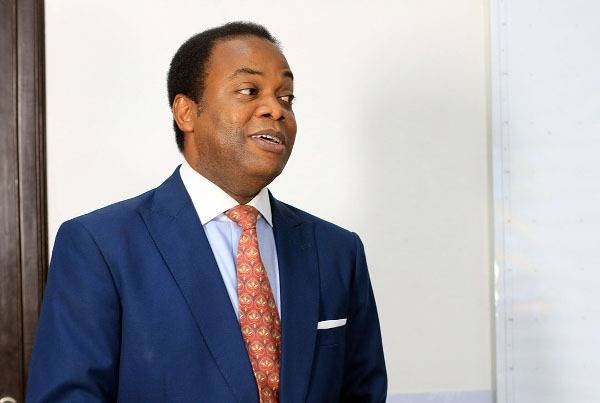

Former Cross River state governor and presidential candidate of Peoples Redemption Party (PRP), Donald Duke, has said Nigeria’s economy has effectively shrunk since the Second Republic because government spending and productive capacity have failed to grow in line with the country’s population.
Duke said Nigeria was still operating around the same dollar-denominated budget recorded under former President Shehu Shagari more than four decades ago, despite its population increasing from about 76 million to an estimated 230 million.
Speaking to journalists in Abuja Tuesday, he blamed the country’s worsening cost-of-living crisis on decades of neglect of productivity.
“I think we got it wrong from independence, but as the years go by, the effects become stark. We have not addressed the issue of productivity,” he said.
Duke said Shagari’s administration operated an average annual budget of about $25 billion between 1979 and 1983, when Nigeria’s population was approximately one-third of its present size.
“Today, our population, they say, is about 230 million people. We are still spending the same $25 billion that Shagari spent 46 years ago,” he said.
“All these trillions and trillions, by the time you convert them, you come down to the same thing.
“In essence, the economy has not grown. In fact, it has shrunk because $25 billion in 1979 or 1980 is not the same as $25 billion today.”
He said the consequences could be seen in widespread poverty, unemployment, insecurity and the desperation of millions of Nigerians struggling to survive.
He added that the primary responsibility of the government is to create conditions that allow citizens to be productive within a secure and orderly society.
The former governor also questioned the economic justification and timing of the Lagos–Calabar Coastal Highway, saying the government should have considered more urgent social and infrastructure needs.
“We woke up one morning and said we wanted to build a road from Lagos to Calabar. What are the economics? How many communities will it go through?
“A road is commuting infrastructure between communities. There are existing roads. What happens to those roads? What happens to the East-West Road that we have been talking about?,” Duke asked.
Duke said he would personally benefit from the coastal highway because of his connections to Lagos and Calabar, but insisted that public expenditure must be determined by national priorities and measurable economic value.
“I would be the happiest person because I live in Lagos and Calabar. I would be going back and forth,” he said.
“But even if it were the best road, with a sea view as you are going to Calabar, what is the economics of it? What is the opportunity cost?
“Maybe you can say we will do it in 10 years when we can afford it. We cannot afford it now. There are higher priorities.”
He cited the number of children outside the school system and the growing population of poor Nigerians as areas demanding more urgent government intervention.



APC presidential campaign council to Atiku: Explain legal basis, ₦21 trillion cost of petrol subsidy plan

2027: Remo group warns sons against breaking Ogun zoning pact

Emulate Uba Sani on mass transit scheme – Tinubu to govs

37 miners’ death: I’m just chief security officer by mouth – Gov Bago

Ebonyi commissioner’s sack: Odii threatens lawsuit over alleged embezzlement

FIDA demands independent probe into death of 37 miners in NSCDC custody

Fight against illicit drugs requires coordinated approach – Cross River CP, Ordue

NDLEA officer drowns while chasing drug suspect into Delta river
-

 News3 days ago
APC presidential campaign council to Atiku: Explain legal basis, ₦21 trillion cost of petrol subsidy plan
- Politics3 days ago
2027: Remo group warns sons against breaking Ogun zoning pact
- Breaking3 days ago
Emulate Uba Sani on mass transit scheme – Tinubu to govs
- Breaking2 days ago
37 miners’ death: I’m just chief security officer by mouth – Gov Bago