News
Nigeria’s energy transition must reflect development realities – FG

Nigeria’s energy transition must reflect development realities – FG
Benjamin Umuteme
The Federal Government has said Nigeria’s energy transition must reflect its development realities, positioning natural gas as a transition fuel and industrialisation driver rather than mainly an export commodity.
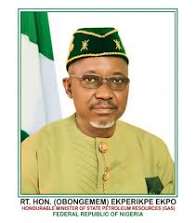
Minister of State for Petroleum Resources (Gas), Ekperikpe Ekpo, said this on Thursday in Abuja at the 2026 annual conference of the Association of Energy Correspondents, Abuja, themed “Sustaining Oil and Gas Investment in Nigeria Amid Energy Transition.”
Ekpo said the government supports the global shift to cleaner energy, but millions of Nigerians still need reliable electricity and clean cooking fuels, while industries need affordable, dependable energy.
He said: “It is important to emphasise that Nigeria’s energy transition must reflect our development realities. We support the global movement towards cleaner and more sustainable energy systems, but our transition must also address our immediate energy needs. Millions of Nigerians still require reliable electricity and access to cleaner cooking fuels, while our industries require affordable and dependable energy. Natural gas therefore has an important role to play as a transition fuel and as an enabler of industrialisation,” he said.
He said the Decade of Gas Initiative is driving a shift from treating gas mainly as an export commodity to using it domestically for power, manufacturing, fertiliser, petrochemicals and transportation.
He cited the AKK and OB3 gas pipelines, gas processing, LNG and other midstream projects as critical to connecting gas to markets. He added that the government is promoting LPG and CNG to widen access to cleaner, cheaper energy.
On investment, Ekpo pointed to the Petroleum Industry Act 2021 and ongoing reforms as efforts to give investors clarity, but conceded that “legislation alone is not sufficient.” Investors, he said, need confidence that policies will be consistently implemented and projects executed profitably.
He listed infrastructure constraints, security, operational inefficiencies, contracting timelines and regulatory bottlenecks as issues hurting project economics. Operators, he added, must also invest responsibly and uphold safety and environmental standards.
“At the same time, sustaining investment in the petroleum sector will require greater efficiency across the industry. We must continue to address issues that affect project economics, including infrastructure constraints, security, operational inefficiencies, contracting timelines and regulatory bottlenecks.
“Government has a responsibility to create the enabling environment, while operators must continue to invest responsibly, improve efficiency and uphold the highest standards of safety and environmental performance,” he said.
The minister urged energy correspondents to give the public accurate context and balanced analysis, saying the media can help build investor confidence by highlighting opportunities while constructively interrogating policies and projects.
He said the government’s objective is a competitive, investment-friendly petroleum industry that keeps oil and gas contributing to national development as the energy mix is progressively diversified.
NUPRC urges operators to deliver capital, production
In her goodwill message, Commission Chief Executive Engr. Oritsemeyiwa Eyesan, Nigerian Upstream Petroleum Regulatory Commission (NUPRC) declared that Nigeria is actively strengthening its upstream investment environment, shifting focus from resource availability to converting opportunities into committed capital and actual production.
Eyesan, who was represented by Director, Sub-Surface Development, Joseph Ogunsola, outlined the regulator’s strategic roadmap to boost output and secure Nigeria’s energy future.
The CCE emphasised that Nigeria does not suffer from a lack of oil and gas resources.
She said: “Our position: Nigeria does not have a shortage of resource opportunities. The issue is converting that opportunity into committed capital, producing assets, and economic value. Our job is to make sure a good Nigerian project is not made uncompetitive by avoidable regulatory or operating friction.”
The NUPRC CCE highlighted recent operational successes, noting that crude oil and condensate production recently averaged 1.75 million barrels per day, meeting the country’s OPEC quota for the fourth consecutive month. She affirmed that production growth relies on protecting base assets through brownfield interventions and debottlenecking, noting, “Production growth is built first by protecting the base, and then by adding the next barrels.”
To accelerate project execution, Eyesan pointed to ExxonMobil’s $1 billion Usan infill commitment—expected to yield 40,000 barrels per day as a key milestone.
“An approved project is a strong start. The real outcome is when capital is committed and production follows,” she added.
Eyesan also reiterated the Commission’s focus on decarbonisation, lower-emissions projects like the TotalEnergies/AMNI Ima gas development, and strict emissions measurement, stressing: “We can make the path clearer, but industry still has to walk it and the measure is delivery.”
AECAF wants policy stability
In his welcome address, Chairman Association of Energy Correspondents Abuja FCT (AECAF), Mr John Ofikhenua, called for consistent policy implementation, improved security and strict adherence to the Petroleum Industry Act (PIA) to sustain investment in Nigeria’s oil and gas sector amid the global energy transition.
Mr Ofikhenua said investment in hydrocarbons had repeatedly suffered setbacks from global events, hostile business decisions and shifting energy policies.
The AECAF Chairman stated that the theme was designed to spur discussion on retaining and renewing investor confidence in Nigeria’s fossil-fuel industry, despite the push towards greener energy sources.
“Investment is often the casualty of adverse policies adopted by companies and governments,” he said, recalling the impact of the United States shale-oil boom, the COVID-19 pandemic and the energy-transition campaign on oil-sector funding.
He noted, however, that recent global developments had reinforced the strategic relevance of hydrocarbons, prompting a shift in emphasis from an outright energy transition to an energy mix.
“Today, the narrative is changing in favour of investment in the nation’s hydrocarbon industry,” Ofikhenua said.
He cited investor interest in the Dangote Petroleum Refinery and Petrochemicals’ Initial Public Offering, as well as participation in the Nigerian Upstream Petroleum Regulatory Commission’s oil and gas field bid rounds, as indications of renewed confidence.
The chairman said Nigeria must preserve the gains of the PIA, strengthen security, particularly in the Niger Delta, and end policy reversals to attract fresh capital.
“Nigeria can only sustain investors’ confidence with enduring and stable policies,” he said.



AFC supports ₦729 billion series 2 bonds to advance Nigeria’s power sector reforms

Constitution doesn’t recognise ‘working’ vacation – ADC challenges National Assembly over Tinubu’s absence

Super Eagles: Brentford defender Kayode reveals he was approached by Nigeria

I’ve never had problems with artistes- Rema addresses alleged fight with Davido [VIDEO]

Oyo 2027: Adelabu Distances Self From Ex-Aide’s Defection to APM

CBN Slashes Benchmark Interest Rate to 23% at MPC Meeting

FG working to announce new minimum wage – Shoretire

Obtain medicines from legitimate sources to avoid complications- PSN warns Nigerians
-

 News1 day ago
AFC supports ₦729 billion series 2 bonds to advance Nigeria’s power sector reforms
- Breaking3 days ago
Constitution doesn’t recognise ‘working’ vacation – ADC challenges National Assembly over Tinubu’s absence
- Breaking3 days ago
Super Eagles: Brentford defender Kayode reveals he was approached by Nigeria
- Breaking3 days ago
I’ve never had problems with artistes- Rema addresses alleged fight with Davido [VIDEO]