Society
Flooding: FCTA Begins Citywide Drain Clearing

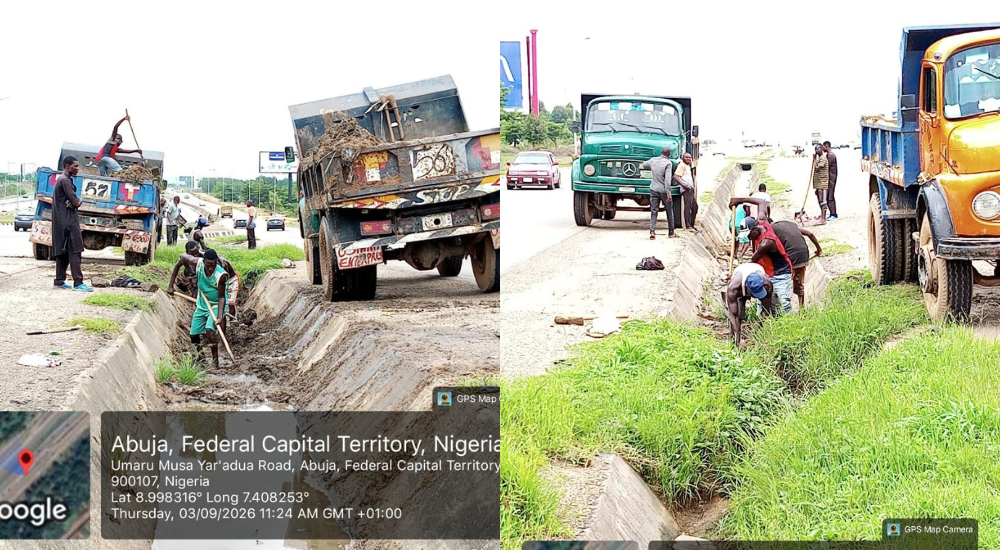
The Federal Capital Territory Administration (FCTA) has begun desilting drains and clearing blocked drainage infrastructure across Abuja following heavy rainfall and flash floods recorded in parts of the city two days ago.
The administration also plans to remove structures erected by developers that have narrowed natural waterways and restricted the flow of stormwater.
The Acting Executive Secretary of the Federal Capital Development Authority (FCDA), Richard Dauda, disclosed this on Thursday during an inspection of drainage facilities along the Airport Expressway and other areas affected by the downpour.
Dauda said the intervention followed a directive by the FCT Minister, Nyesom Wike, for relevant agencies to immediately desilt drains, culverts and other drainage infrastructure across the city.
He said accumulated silt, sand, grasses, refuse and other debris had blocked some drainage facilities, preventing them from discharging water at their designed capacity.
According to him, the heavy rainfall two days earlier was consistent with meteorological forecasts of heavy downpours during the 2026 rainy season, while climate change had increased the intensity of extreme weather events.
“Climate change is also evident and with that, there was the torrential rainfall that came with some flash floods,” Dauda said.
He said the Abuja Master Plan had taken the city’s geographical characteristics and the possibility of flooding in some locations into account, with drainage infrastructure provided to manage stormwater.
“Actually, because of the location of the city, it is evident even from the Master Plan that we will have some flash floods. What is required is resilient infrastructure. That has been provided,” he said.
Dauda said the Airport Expressway had adequate drainage infrastructure, but some facilities had become silted over time and were no longer functioning optimally.
He also blamed indiscriminate dumping of refuse for some blockages, saying plastics, polythene bags and other objects were washed into drainage channels during rainfall.
He said, “When rain falls, it washes them down, and in some cases, you see large objects. These large objects, when they get to the outlets, they block it.
“And once that is blocked and the sand is also washed, the drainage facility is no longer able to function the way it should.”
The FCDA boss identified encroachment and the constriction of natural waterways by developers as another cause of flooding in the territory.
He pointed to a stream running from Galadima Roundabout and crossing the Airport Expressway through a triple-cell box culvert measuring three metres by three metres.
According to him, the waterway carries a large volume of water during rainfall, but a developer downstream had constructed retaining walls that narrowed the channel in an attempt to create more land within the plot.
He said the obstruction had reduced the volume of water that could pass through the channel, resulting in detention, backflow and eventual overflow.
“So, what needs to be done is to remove this structure that the developer has put there so that we can have the adequate volume of discharge and adequate width of the stream channel,” Dauda said.
He warned that interference with waterways could undermine existing drainage infrastructure and worsen flooding in the city.
Dauda also raised concerns over the vandalisation of gully inlet covers along roads, saying their removal allowed debris to enter the drainage system unchecked.
He said the covers were designed to prevent large debris from entering the drainage system and that their removal had contributed to drain blockages.
“When vandals steal this, it opens the drains. Now, the inlets are supposed to sieve the debris so that it can be swept up, but once it is no longer there, all debris now goes into the gully inlets,” he said.
The FCDA is considering alternative materials for replacing stolen gully inlet covers, particularly materials that are not easily recyclable, Dauda said.
He said the replacement of stolen covers would be carried out progressively.
“The authority is looking at the option of providing materials that are not recyclable other than steel and cast iron, so that these can be replaced,” he said.



Access Holdings Extends Trading Dominance With Nearly 130 Million Shares

10 Years. ₦1.2bn. 40+ Tertiary Institutions by 2026. OPay Is Here to Stay

Nigeria reclaims Africa’s stock-market crown from Zimbabwe as FTSE return lifts sentiment

2027: Forget second term if US releases your documents – Primate Ayodele warns Tinubu

Police arrest five over alleged possession of human eyes in Bauchi

Insurance Stocks Sustain Rally as SUNU, Sovereign Record Back-to-Back Gains

Nigeria’s inflation shock is rewriting what consumers consider value

Northern youths threaten firm handling N525bn Kaduna-Abuja road over ‘assault’
-

 Finance2 days ago
Access Holdings Extends Trading Dominance With Nearly 130 Million Shares
- News2 days ago
10 Years. ₦1.2bn. 40+ Tertiary Institutions by 2026. OPay Is Here to Stay
- Business3 days ago
Nigeria reclaims Africa’s stock-market crown from Zimbabwe as FTSE return lifts sentiment
- Politics3 days ago
2027: Forget second term if US releases your documents – Primate Ayodele warns Tinubu