Special Reports
Doctors confused after finding shocking âforeign bodiesâ inside a manâs chest, pelvis, bladder, and penis

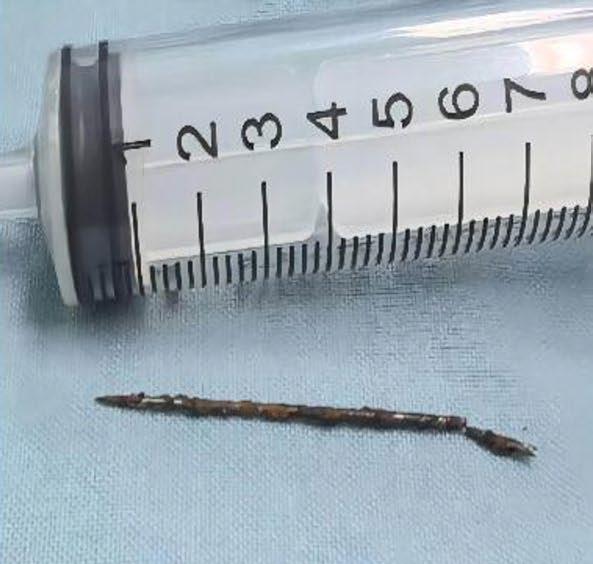

A man’s hospital visit took a bizarre turn when testing revealed multiple “foreign bodies” lodged in his heart, abdomen, pelvis, bladder and even his penis.
Doctors suspect the man put the foreign bodies in his body by himself.
The strange case presented at a hospital in China, where the man sought treatment for discomfort while urinating and blood in his pee.
For the most part, he appeared to be in good health. The 35-year-old’s vital signs were stable, and he had no other symptoms or obvious signs of distress.
However, doctors noticed something unusual on an imaging test: a shadow-like shape near his heart.
Eager for a closer look, they ordered a contrast-enhanced CT scan. The test delivered a shocking surprise, showing multiple “needle-like metallic foreign bodies” scattered inside his body.

Most concerning, perhaps, was a 1.4-inch pin that had pierced the fluid-filled sac surrounding his heart, known as the pericardium.
How the needles got there was a mystery.
The man, who had a childhood history of intellectual disability, couldn’t explain them, and neither could his father, who served as his legal caregiver.
But there was a clue. Two years earlier, doctors at another hospital had removed two foreign objects from the man’s abdomen.
That history led them to suspect that the man was self-embedding, a form of non-suicidal self-injury in which people deliberately insert foreign objects into their bodies, such as glass, staplers, paper clips and wire.
While rare, the perplexing practice has been documented for decades. One of the earliest known cases dates to 1936, when serial killer Albert Fish was found to have nearly 30 needles embedded in his groin, along with additional needles in his abdomen.
The patient in China was already facing a potentially life-threatening case. The needle near his heart posed a serious risk, but removing some of the others could also cause significant damage.
Ultimately, they opted to focus on the most dangerous object first.
Surgeons successfully removed an intact, black metallic sewing needle from the patient’s pericardium, finding that it was corroded — a sign that it had been inside his body for or an extended period of time.

Doctors found no obvious entry wound or scar on the man’s chest that would explain how the object had gotten there.
After surgery, the man’s heart function took a nosedive as it grappled with existing injury from the needle, along with the stress from surgery.
The patient was discharged from the hospital nine days after surgery, and at a nine-month follow-up appointment, he was still clinically stable and his heart function had recovered.
As for the other needles scattered around his body, doctors opted to monitor them closely rather than risk complications from immediately removing them.



Ogun 2027: Yayi, Hunye clash over Ekiti origin claim

Security operatives arrest three suspected kidnappers, rescue victims in Edo

₦1,470 Petrol: ADC Says Tinubu Pushing Nigerians To Breaking Point

2027: InterSociety threatens int’l sanctions against Soludo, Alia, four other govs

NNPCL increases Petrol Price by up to â¦85 per litre

2027: I never promised Tinubu I would join APC – Wike

Nigerian man beats 61-year-old railway worker to d3ath after missing his train in UK

2027: Tinubu’ll defeat Atiku, Peter Obi – Fayose
-

 Politics3 days ago
Ogun 2027: Yayi, Hunye clash over Ekiti origin claim
- Politics3 days ago
Security operatives arrest three suspected kidnappers, rescue victims in Edo
- News2 days ago
₦1,470 Petrol: ADC Says Tinubu Pushing Nigerians To Breaking Point
- Politics2 days ago
2027: InterSociety threatens int’l sanctions against Soludo, Alia, four other govs