News
Africa turns to aquaculture as fish stocks decline, food security threatens


Africa may have to look increasingly towards aquaculture to meet rising demand for fish, create jobs and protect dwindling marine resources as declining catches and rapid population growth place mounting pressure on traditional capture fisheries.
This was the central message from a high-level meeting on aquaculture development held in Dakar, Senegal, from October 7 to 8, 2026, where fisheries policymakers, researchers, development institutions and private-sector stakeholders examined the role fish farming could play in securing Africa’s food future and expanding economic opportunities.
The meeting, held under the theme, “What contribution can aquaculture make to inclusive growth, sustainable development, and job creation in Africa?”, brought renewed attention to the need for African countries to diversify their sources of fish production as pressure on natural fisheries resources continues to increase.
The event was jointly organised by the African Network of Institutions for Aquaculture Development and Promotion (RAFAQUA) and the African Network of Fisheries Research and Marine Science Institutes (RAFISMER), under the auspices of the Ministerial Conference on Fisheries Cooperation among African States Bordering the Atlantic Ocean (COMHAFAT).
Representatives from COMHAFAT’s 22 member states participated in the meeting alongside institutions and organisations including the Sub-Regional Fisheries Commission (CSRP), Portugal’s AIR Centre and the OMPDA.
The gathering provided a platform for countries to exchange experiences, identify common challenges and promote greater cooperation among COMHAFAT member states through the RAFAQUA and RAFISMER networks.
At the centre of the discussions was a growing concern that Africa cannot continue to rely overwhelmingly on capture fisheries to satisfy the needs of an expanding population.
Opening the meeting, Mr. Baba Ndiaye, Chief of Staff to Senegal’s Minister of Fisheries and the Maritime Economy, welcomed the gathering and linked aquaculture development directly to some of the continent’s pressing food and socio-economic challenges.
He said declining fish catches, combined with rapid population growth, had created an urgent need for alternative and sustainable sources of fish production.
According to him, aquaculture had emerged as a credible option for helping African countries bridge the widening gap between fish supply and demand while contributing to food security, employment and income generation.
“Aquaculture now emerges as a credible alternative capable of bridging the gap and contributing significantly to achieving food security goals, creating jobs and income, and combating illegal migration,” Ndiaye said.
His position reinforced the growing argument for a gradual transition from excessive dependence on capture fisheries towards a more diversified system in which fish farming becomes a strategic component of national food and economic policies.
The proposal has significant implications for a continent where fish remains an important source of food, nutrition and livelihood for millions of people.
As populations expand and urbanisation accelerates, demand for affordable animal protein is expected to remain strong.
At the same time, pressure on wild fish stocks and other environmental challenges could make it increasingly difficult for traditional fishing alone to satisfy future demand.
Aquaculture therefore offers an opportunity not simply to supplement wild fish production, but also to build a broader economic value chain.
The industry can create opportunities for hatchery operators, feed manufacturers, farmers, processors, transporters, cold-storage businesses, marketers, equipment suppliers and other service providers.
For young Africans confronted by unemployment and limited economic opportunities, a commercially viable aquaculture industry could provide jobs and entrepreneurship opportunities across rural and urban communities.
But stakeholders at the Dakar meeting made it clear that achieving this potential would require far more than encouraging people to establish fish ponds.
President of RAFISMER, Mohamed Najih, said the transition would require countries to abandon isolated approaches and strengthen partnerships among policymakers, research institutions, private investors and development partners.
“The success of this transition requires breaking away from isolated approaches. We need strong synergy among policymakers, research institutes, the private sector, and our development partners,” Najih said.
He also stressed the role of government in creating an environment capable of attracting investment and supporting sustainable production.
“The State must play its role as a facilitator by securing investments, standardizing production zones, and modernizing supporting infrastructure,” he added.
His comments underscored one of the major challenges facing aquaculture development across Africa: the gap between the sector’s potential and the infrastructure and investment needed to unlock it.
Commercial fish farming depends on several interconnected factors, including quality fingerlings, affordable and reliable feed, suitable production facilities, clean water, technical expertise, disease management, electricity, transportation, processing facilities and access to markets.
Where these inputs are unavailable or expensive, production costs can rise sharply, reducing farmers’ profitability and making locally produced fish less competitive.
Stakeholders therefore stressed the need for an integrated aquaculture value chain rather than an approach focused solely on increasing the number of fish farms.
Research institutions will also have an important role to play.
African fisheries and aquaculture research institutions can help develop production systems adapted to local conditions, improve fish breeds, address diseases, enhance feed efficiency and provide technical support to farmers.
Stronger regional networks could allow countries to share technologies, research findings and practical experiences instead of repeatedly confronting similar challenges independently.
President of RAFAQUA, Mr. Samba Ka, reinforced the need for such cooperation, calling for coordinated action.
“We must work together to find sustainable solutions,” Ka said.
The call for greater cooperation also reflects the transboundary nature of Africa’s fisheries and marine resources.
The participation of 22 COMHAFAT member states provided an opportunity for countries to compare experiences, identify common challenges and explore areas of collaboration.
The presence of the CSRP, Portugal’s AIR Centre and the OMPDA further broadened the platform for institutional and international cooperation.
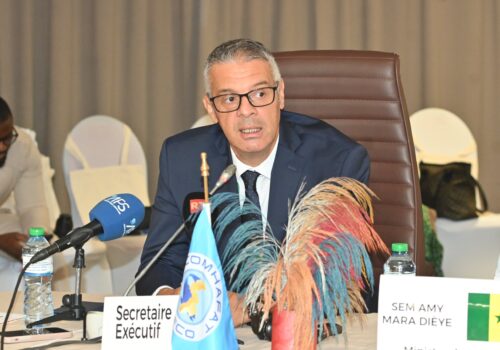
For COMHAFAT Executive Secretary, Mr. Taoufik El Ktiri, the quality of presentations and contributions demonstrated the seriousness with which stakeholders were approaching the development of the sector.
He praised participants for their contributions, saying the discussions reflected a commitment to building a sustainable, competitive, profitable and equitable aquaculture sector for Africa.
The emphasis on sustainability is particularly important because expanding aquaculture must itself be carefully managed.
While fish farming can help reduce pressure on wild fish stocks by providing an alternative source of fish, poorly managed operations can generate environmental problems, particularly around water use, waste management and production practices.
The expansion of aquaculture must therefore be accompanied by effective regulation, environmental standards, responsible production systems and monitoring mechanisms.
Beyond food security, stakeholders see aquaculture as an important economic development opportunity.
A stronger fish-farming industry could attract private investment, stimulate rural economies and create businesses around processing, transportation, storage, packaging and marketing.
It could also expand opportunities for women and young people, particularly through small and medium-sized enterprises connected to the aquaculture value chain.
That economic dimension gives aquaculture relevance beyond conventional fisheries policy.
For countries struggling with unemployment, poverty and irregular migration, the creation of sustainable livelihoods could help address some of the economic pressures that encourage young people to leave their communities in search of opportunities elsewhere.
The Senegalese position that aquaculture could contribute to combating irregular migration therefore reflects a broader understanding of fish farming as part of an employment and development strategy.
But converting that potential into reality will require governments to move from policy declarations to practical action.
Investment incentives, access to land and water, improved infrastructure, research funding, training programmes and efficient regulatory systems will be necessary to attract investors and encourage existing farmers to expand.
Financial institutions also have a role to play by developing financing products suited to aquaculture businesses, particularly small and medium-scale operators that may struggle to obtain conventional credit.
Development partners could complement these efforts through technical assistance, capacity building and investment support.
The Dakar meeting consequently placed cooperation at the centre of Africa’s aquaculture ambitions.
Rather than individual countries attempting to solve production, financing, research and market challenges independently, platforms such as RAFAQUA and RAFISMER provide opportunities to pool knowledge and coordinate approaches.
The objective is to ensure that Africa develops an aquaculture industry that is not only larger but also productive, profitable, competitive and environmentally sustainable.
For Africa, the urgency is becoming increasingly evident.
Population growth is increasing demand for food, while pressure on natural resources is intensifying. Governments are simultaneously under pressure to create jobs, raise incomes and provide sustainable livelihoods for their populations.
Aquaculture sits at the intersection of these challenges.
If properly developed, it can contribute to food production while supporting employment, entrepreneurship, investment and rural development.
However, stakeholders at the Dakar meeting also made clear that fish farming cannot succeed through government action alone.
The private sector must be encouraged to invest. Research institutions must develop appropriate technologies. Farmers must gain access to affordable inputs and reliable markets. Development partners must support capacity building and financing, while governments provide the infrastructure and regulatory environment required for sustainable growth.
The challenge, therefore, is not simply to produce more fish.
It is to build a complete, competitive and sustainable industry around aquaculture.
For Africa, that means transforming fish farming from a fragmented activity into a strategic economic sector capable of contributing meaningfully to food security and employment.
The Dakar meeting has provided renewed momentum for that ambition by bringing together countries and institutions around a shared recognition that the continent needs a more sustainable approach to meeting future fish demand.
As capture fisheries face increasing pressure and populations continue to grow, the ponds, tanks and farms of Africa could become increasingly important to the continent’s food security alongside its rivers, lakes and oceans.
For stakeholders gathered in Dakar, the message was clear: Africa needs to act now to transform aquaculture into a strategic sector capable of feeding people, creating jobs, generating income and supporting sustainable development.
The real test, however, will be whether the commitments made in Dakar translate into investment, research, infrastructure, policy reform and practical support for fish farmers across the continent.
If that happens, aquaculture could emerge not merely as an alternative to declining capture fisheries, but as one of Africa’s important engines of inclusive growth.



Sowore Demands ₦500,000 Minimum Wage for INEC Staff

South-east group defends Orji Kalu over ₦14.286 billion constituency projects

Kayode Akinmade: ₦3.5bn Ogun LG severance: When leadership meets compassion

Woman found behaving strangely after allegedly being dumped by roadside in Abuja (video)

25-year-old remanded over alleged N15m cattle robbery in Benue

Chaos in Ondo as okada riders, ticket sellers clash over multiple levies

NAF plane crash, national loss – PDP Chieftain, Coffie

Aircraft crash: PDP mourns, demands thorough investigation
-

 Breaking3 days ago
Sowore Demands ₦500,000 Minimum Wage for INEC Staff
- News2 days ago
South-east group defends Orji Kalu over ₦14.286 billion constituency projects
- Breaking1 day ago
Kayode Akinmade: ₦3.5bn Ogun LG severance: When leadership meets compassion
- Special Reports2 days ago
Woman found behaving strangely after allegedly being dumped by roadside in Abuja (video)