News
Nigerians to governors: What have you done with subsidy windfall?

‘Mr. President has done his part by freeing the funds’
…There’ve been little or no investments in
…Many govs, LG chairs have treated the windfall like free cash – Agbor
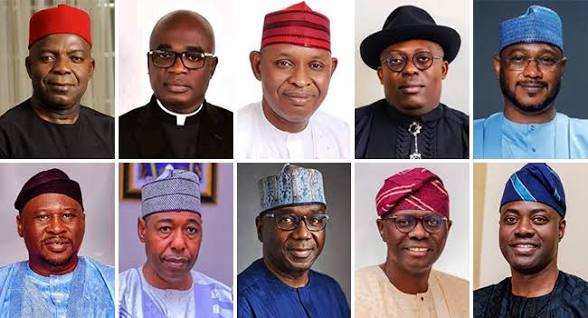
Governors of the 36 states
In July 2026, the allocations to the states reached a record N3.007 trillion, making it the first time the monthly Federation Account Allocation Committee distributions crossed the N3 trillion mark.
Recently, the Minister of Finance and Coordinating Minister of the Economy, Taiwo Oyedele, recently gave a breakdown of how the proceeds from fuel subsidy removal were disbursed among the three tiers of the government at a media conference on the scorecard of Nigerian reforms from 2023, when the current administration assumed office.
He put the total incremental resources from subsidy savings from June 2023 to December 2025 at N15.8 trillion. According to the figure, N5.4 trillion went to the federal government, while N10.4 trillion or 66 per cent was shared among the states and local governments.
Reactions, admonitions
In his reaction, a political economist, Dr. Jude Agbor, called for an independent commission to probe state and local government spending of the subsidy monies.
He said, “When President Bola Ahmed Tinubu removed fuel subsidies on May 29, 2023, he took a painful but necessary step. That decision stopped the bleeding of trillions of the naira and increased the revenue shared among the federal, state, and local governments through the Federation Account Allocation Committee (FAAC). States and local governments began to receive far more money than ever before.
“Three years later, most Nigerians cannot point to a single new hospital, good road, or reliable power supply in their communities. What we see instead is shocking. Many governors and local government chairmen have treated this windfall like free cash. They are buying luxury vehicles for traditional rulers, throwing money at political supporters, and funding lavish lifestyles, while the people who paid the price of subsidy removal continue to suffer.
“Mr. President has done his part by freeing the funds. He even publicly urged Nigerians to hold their governors and local government chairmen accountable for how this money is spent. But the truth is that ordinary citizens lack the power, tools, and protection to investigate those who control the police and local institutions. That is why we need an independent commission of inquiry – one with real teeth, staffed by credible Nigerians of integrity, and backed by law to probe how every state and local government has spent its increased FAAC allocations since the subsidies were removed.
“This Commission should audit all funds received by each state and local government from June 2023 to date, compare what was collected with what is actually on the ground in terms of infrastructure and public services, identify cases of diversion, contract fraud, and wasteful spending and recommend prosecution and the confiscation of properties acquired with stolen public funds.”
Continuing, he said, “Without punishment, this looting will not stop. The ruling class will continue to treat the treasury like a personal ATM until they see their colleagues in prison and their ill-gotten wealth seized. The fear of prison, not speeches, is what changes behaviour.”
Also, another economist and lecturer at Federal University Lokoja, Dr. Abdulmumin Abdulmalik, said most governors have not done enough with the windfall to benefit their states.
“Since May 2023, when President Bola Ahmed Tinubu removed subsidies on petrol, Nigerians have been groaning from the pains inflicted on them by the decision. The subsidies’ cut led to massive increase in the costs of transportation, food, consumer goods, house rents, and other essentials for daily living.
“On the flipside, governors of the 36 states and the minister of the Federal Capital Territory (FCT) celebrate every month as the funds from subsidy removal are channelled into the coffers of the states.
“In 2024 alone, Nigerian governors collectively received N5.22 trillion -a 45.5 per cent increase from the previous year, 2023 -while local governments also saw a staggering 96 per cent increase in their allocations. Governors still control local government funds despite the Supreme Court’s pronouncement against it in 2024,” he said.
He continued: “Governors are not in denial about the fortune they receive from the Federation Account as a result of the subsidy removal.
“The funds from the subsidy have indeed been a blessing to governors, but they have not, in any meaningful way, improved the lives of ordinary Nigerians.
“Primarily, the funds should have been re-distributed in a manner that would ease the impact of the subsidy removal on Nigerians. This has not been done.”
Larger budgets vs. citizens’ welfare
Also, Dr. Stanley Nwani, a university lecturer, decried the gap between larger government budgets and citizens’ welfare, arguing that increased public resources had not translated into commensurate improvements in living conditions.
Nwani blamed the ugly trend on weak project-monitoring and poor price regulation across the three tiers of the government. He also said greater scrutiny of state and local governments’ finances was needed, noting that the media and citizens had historically paid more attention to the federal government.
“While some governors have linked higher FAAC receipts to road construction, bridges, healthcare, education, workers’ welfare, and other projects, in some states the increased revenue had not resulted in improved public services or reduced economic hardship,” he said.
Infrastructure neglect
Similarly, a public affairs analyst, Mr. Jide Olamilekan, said there are no investments in infrastructure and social amenities to justify huge allocations to states.
He said, “It follows, therefore, that Nigerians are forced to bear the brunt of inflated costs for everyday goods. To make matters worse, there is no visible government intervention in health care as citizens pay out-of-pocket for medications.
“Nigerians in rural areas lack access to qualified medical doctors. The education sector is in shambles—public schools are starved of basic teaching aids, laboratories, libraries and qualified teachers.
“Roads, both state and federal, are in deplorable conditions, and peasant farmers who produce the bulk of the food Nigerians consume are left to their own devices to fend off bandits and procure inputs at unaffordable prices.
“In essence, the nation’s governors have failed to invest the excess funds in sectors and institutions that would benefit the citizens. Many governors throw vast sums of money into what they consider to be legacy projects; projects that bear their signatures.”
Furthermore, he said, “Notable among such vanity projects is the construction or renovation of Government Houses at exorbitant costs. Other states build fanciful flyovers where they are neither needed nor useful.
“These are the vanity projects that Nigerians can see with their own eyes, but behind the scenes, governors funnel even more money into phantom and fictitious projects that remain invisible to the public.”
State assemblies to act
Olamilekan advised the governors on how to appropriate funds from subsidy removal, urging Houses of Assembly to check excesses of the governors.
He said, “Certain ways of utilising such funds include subsidising public transportation, improving hospitals, equipping primary health centres and ensuring access to affordable health care.
“The funds could be used to renovate schools, hire qualified teachers and provide learning materials, build and maintain roads, bridges and public transport systems to enhance mobility and commerce or even upgrade electricity and water supply systems, especially in rural areas.
“They could be invested in sectors that could create jobs, like public works, mechanised agriculture, feeder roads construction and the like.”
According to him, “Most governors engage in reckless spending because the arm of the government that should keep them in check is either asleep at the wheel or has been hypnotised by the governors themselves. Section 128 empowers the Houses of Assembly to investigate any person, authority, ministry or government department charged with executing or administering laws, especially in the disbursement or management of public funds.”
He added: “Governors fall squarely within this category. Section 129 empowers the Assembly to summon witnesses, issue subpoenas and compel the production of documents, while Section 188 provides for impeachment proceedings if corruption or fraud amounts to gross misconduct. Our Houses of Assembly must wake up to their responsibilities -they are the voice of the grassroots and must hold governors accountable to the people.”
Advice to the governors
In his contribution, a public policy analyst, Dr. Shuab Alkali, called on the Nigerian Governors Forum (NGF) to come together and articulate how the excess funds should be applied.
He said the organisation has a think-tank capable of studying how such funds are used for the public good in other societies and advising our governors accordingly.
“The current trend, where governors live recklessly, burn public funds on overseas junkets, launder state funds to acquire properties in Abuja, Dubai and Europe and bask in luxury spells doom for the people. Our governors must be called to order,” he said.
He called on Nigerians to direct their demands for accountability toward state governors rather than the President, emphasising the distinct constitutional responsibilities of each tier of the government.
“A significant portion of developmental responsibilities estimated at about 80 percent lies with state governments. Governors are constitutionally empowered and sufficiently resourced to drive infrastructure, economic growth, and social development within their respective states.
“Citizens must begin to hold their governors accountable for the development of their states. Misplaced blame on the presidency distracts from the performance evaluation of state leadership.”
He also highlighted concerns about governance at the sub-national level, suggesting that limited accountability mechanisms have allowed some state executives to operate with minimal scrutiny.
He said, “According to BudgIT’s Nigeria’s Economic Reforms report, aggregate revenue of the 36 states rose from N4.84 trillion in 2022 to N15.53 trillion in 2025, representing a 220.76 per cent increase.
“The increase was driven largely by higher allocations from the Federation Account Allocation Committee (FAAC) following the removal of the petrol subsidy and the unification of the foreign exchange market.
“However, the increase in resources has not been matched by a corresponding improvement in spending on key social sectors or fiscal discipline, the report found.”
Also, Nwani said, “State governments have no justification for failing to cushion the economic hardship facing residents. Governors must account for the billions of the naira flowing into their coffers. Part of the post-subsidy revenue should be used to subsidise transportation within their states.
“FAAC allocations to states rose from N2.8tn in 2022 to about N7.3tn in 2025, following the removal of petrol subsidies, thus creating room for social interventions.”
He argued that governors should devote five per cent of their allocations to transport subsidies, while using the balance to fund other responsibilities.
“If a governor cannot find five per cent to stop his own people from suffering, then the problem in that state was never money,” he said.
He proposed free transportation for students and a maximum of N500 intra-city fare, saying states could achieve this by registering commercial transport operators, regulating fares, and reimbursing drivers for the difference.



AFC supports ₦729 billion series 2 bonds to advance Nigeria’s power sector reforms

Wike Rejects Election Rigging Allegations, Says G5 Strategy Outsmarted Atiku

AFCON 2027Q: Keep crying – Nwabali fires back at critics after Super Eagles return

Polygamous Ghanaian man shares maternity photos with his two wives

Court orders enforcement against Rahamaniyya group Chairman’s properties over $40m debt

Four die as boat carrying eight capsizes in Jigawa

EFCC Warns: Diverting Tithes, Offerings to Private Businesses Is Criminal Offence
Man reportedly caught after withdrawing â¦1.4m from stroke-battling motherâs account to fund betting
-

 News2 days ago
AFC supports ₦729 billion series 2 bonds to advance Nigeria’s power sector reforms
- Breaking3 days ago
Wike Rejects Election Rigging Allegations, Says G5 Strategy Outsmarted Atiku
- Breaking3 days ago
AFCON 2027Q: Keep crying – Nwabali fires back at critics after Super Eagles return
- Special Reports3 days ago
Polygamous Ghanaian man shares maternity photos with his two wives