Breaking
Nigeria needs $410bn additional investment for net-zero pathway – Shettima

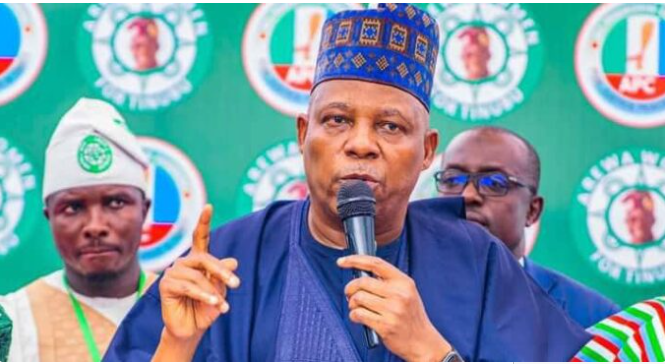
Vice-President Kashim Shettima says Nigeria needs about $410
billion in additional investment by 2060 to achieve its net-zero pathway.
Shettima spoke on Tuesday at the second edition of the
Decarbonising Infrastructure in Nigeria (DIN) Summit in Abuja.
The summit, held at the United Nations House in Abuja, was
organised by the office of the vice-president with support from the National
Council on Climate Change and the United Nations Industrial Development
Organisation (UNIDO).
It was themed, ‘De-risking Green Infrastructure Investment
in Nigeria: Enabling Policy, Project Readiness and Risk-Sharing Solutions’.
Represented by Ibrahim Hadejia, his deputy chief of staff,
the vice president said the funding requirement presented a significant
opportunity for domestic and foreign investors.
“Our energy transition plan estimates that Nigeria will
require about $410 billion in additional investment above business-as-usual
through 2060 to achieve our net-zero pathway,” Shettima said.
“That is a significant financing requirement. But it also
tells us something else: there is a very large investment opportunity ahead of
us.”
He said government could not provide all the capital
required to finance Nigeria’s long-term energy and infrastructure needs,
stressing the need for stronger public-private partnerships and risk-sharing
mechanisms.
“We need the private sector. We need development finance
institutions. We need domestic financial institutions and institutional
investors. And, perhaps most importantly, we need projects that are properly
prepared and capable of attracting that capital,” he said.
Shettima said the challenge was no longer a lack of climate
policies or ambitions but the ability to convert them into projects that
investors could assess, finance and implement.
He said investors needed clarity on policy, credible revenue
models, adequate technical preparation and clear allocation of risks before
committing capital.
“These are practical questions. And I believe that is where
DIN Summit 2.0 can make a useful contribution,” he said.
The vice president said Nigeria’s NDC 3.0 recognised the
need to develop a stronger pipeline of projects with viable financing
propositions, increase private-sector participation and improve access to
climate finance.
$27.2BN ANNUAL FINANCING GAP
Philbert Johnson, UNIDO sub-regional representative in
Nigeria and ECOWAS, said Nigeria’s physical infrastructure investment needs
were estimated at about $3 trillion by 2050.
Johnson said tracked climate finance flows into Nigeria
averaged only $2.5 billion annually in 2021 and 2022, compared with estimated
annual requirements of $29.7 billion.
He said the figures represented an annual financing gap of
about $27.2 billion.
The UNIDO official identified policy and regulatory
uncertainty, fragmented approval processes, unclear institutional mandates and
undefined revenue or offtake arrangements as some of the factors preventing
projects from attracting financing.
“These projects sit at very different stages of maturity,
from concepts which require feasibility work to projects ready to seek
finance,” he said.
Johnson called for the operationalisation of the Climate
Change Act and sanctity of power purchase agreements to help unlock carbon
finance in Nigeria and across Africa.
He said UNIDO would support project development through its
Computer Model for Feasibility Analysis and Reporting (COMFAR) software and
Digital Investment Promotion platform.
According to him, the tools are already used by more than
11,000 practitioners across 160 countries.
Musaddiq Adamu, personal assistant to the president on
subnational infrastructure, said the DIN summit was designed to answer a
practical question: what would it take to move green infrastructure projects
from ideas to investment?
Adamu said the initiative had conducted pre-summit workshops
covering energy, transport, urban development and agriculture.
He recalled that the inaugural summit attracted more than
400 stakeholders and resulted in a green infrastructure investment pipeline and
policy communiqué.
Adamu cited the electrification of port operations as one
outcome of the initiative, saying engagements following a presentation by APM
Terminals at the 2025 summit contributed to a $60 million agreement with the
Nigerian Ports Authority.
He said Onne Port was being positioned to become Nigeria’s
first green port.
“For me, that is an important lesson. The objective is not
simply to have a good conversation. The goal is to create real investment
opportunity,” Adamu said.
Tenioye Majekodunmi, director-general of the National
Council on Climate Change, said green infrastructure could create more than
300,000 jobs.
Click to signup for FREE news updates, latest information and hottest gists everyday
Advertise on NOP NIGERIA to reach thousands of our daily users



“She wants me to stop talking against husband snatchers” — Rita Edochie speaks as she appears in court over the ₦1bn lawsuit filed against her by Judy Austin

“If a man h!ts you once, he will do it again. Value your life and leave” — Rick Ross’ ex-girlfriend Jazzma Kendrick accuses him of ph¥sical ass@ult

Ugochinyere hails APP victory in Yobe LGA poll, says party steadily expanding

“A man can sleep with 30–40 women and still marry, but a woman can sleep with 7–10 men and be rejected” — Veteran actor Chiwetalu Agu

Explainer: Duty-free does not mean tax-free for airport shops

Prolonged absence: Tinubu sued for refusing to hand over power

Lower tax interest to ease burden of business arrears

Nigeria’s foreign reserves hit $54.86 billion as 2026 gain tops $9bn
-

 Special Reports2 days ago
“She wants me to stop talking against husband snatchers” — Rita Edochie speaks as she appears in court over the ₦1bn lawsuit filed against her by Judy Austin
- Special Reports3 days ago
“If a man h!ts you once, he will do it again. Value your life and leave” — Rick Ross’ ex-girlfriend Jazzma Kendrick accuses him of ph¥sical ass@ult
- News2 days ago
Ugochinyere hails APP victory in Yobe LGA poll, says party steadily expanding
- Special Reports2 days ago
“A man can sleep with 30–40 women and still marry, but a woman can sleep with 7–10 men and be rejected” — Veteran actor Chiwetalu Agu