News
Centre to 10th NASS: Don’t close shop without passage of reserved seats bill

… Says countries led with significant female get better development
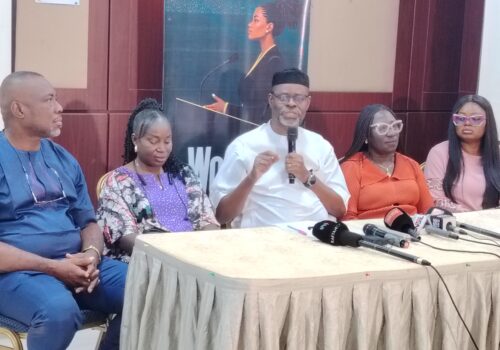
Less than Nine months to the expiration of the 10th National Assembly, the African Centre for Leadership, Strategy and Development (Centre LSD) has called on Senator Godswill Akpabio led NASS to pass the proposed Reserved Seats Bill for women, saying constitutional intervention is necessary to address the persistent under-representation of women in Nigeria’s political leadership.
The is coming even as the Centre launched a new project tagged: “Women Can Lead Project” to train, empower and address challenges depriving most women from participating in governance and decision-making.
The Founding Executive Director of Centre LSD and Project Director, Women Can Lead (WCL) Project, Dr. Otive Igbuzor, made the call in Abuja on Tuesday at a press conference held during the Gender Mainstreaming Training for Gender Desk Officers, faith and traditional leaders and women’s rights organisations.
Igbuzor said Nigeria must adopt deliberate measures to increase women’s representation in governance, arguing that countries that had recorded significant progress in female political participation had used constitutional and institutional mechanisms to address historical inequalities.
He said the proposed reserved or special seats arrangement was one of the measures that could provide women with greater access to legislative positions, urging the National Assembly to take responsibility for ensuring its passage.
According to him, Nigeria remains one of the countries with very low representation of women in political institutions, despite women constituting about half of the population.
“Global experience shows that countries led with significant female participation yield better development outcomes. Nigeria is currently among the nations with the lowest female representation in parliament globally.
“What we all need to do is to appeal to the 10th National Assembly that they can not close shop if they don’t pass the reserved seat bill. History will hold them in good stead if they pass it and history will also write their names in ‘white book’. Their names will be written in ignominy if fail to pass the bill. But Nigeria is on the right track asking for special seat for women.
“The 10th National Assembly has a historical responsibility to pass the Special Seats Bill to alter this trajectory. To pass the reserved seat bill is a responsibility that must be achieved.
He argued that the low number of women contesting elective positions should not be interpreted as a lack of interest or capacity among women, but should be viewed against the historical, economic, institutional and socio-cultural barriers that have limited their participation.
Igbuzor therefore cautioned against asking why women were not coming forward to contest presidential and governorship positions, saying such a question placed the burden on women instead of addressing the structures that make political participation difficult for them.
The Centre called on government institutions at all levels to mainstream gender into policies, programmes, plans and budgets to create opportunities for women inclusion governance and decision-making across the country.
It also challenged traditional and religious leaders to use their considerable influence to challenge harmful norms and practices and promote dignity and equality.
“We therefore call on government institutions to mainstream gender into policies, programmes, plans and budgets. We call on traditional and religious leaders to use their considerable influence to challenge harmful norms and practices and promote dignity and equality.
“We call on men and boys to become active allies in building more equitable families, institutions and communities. We call on civil society and Women’s Rights Organisations to continue demanding accountability and creating platforms for women’s voices. And we call on the media to go beyond reporting the barriers confronting women and deliberately amplify women’s leadership, agency, achievements and stories of change.”
According to the project lead, the “Women Can Lead Project” is a 24-month initiative of Centre LSD supported by the Ford Foundation, with a geographic focus on Benue state, Kano state and the Federal Capital Territory (FCT).
He said the purpose is to create stronger platforms and enabling conditions for women to participate, lead and influence decisions in governance and public life.
“The project brings together three mutually reinforcing areas: gender mainstreaming, meaningful inclusion of women in governance, and feminist strategies for the prevention of gender-based violence (GBV).”
Dr. Igbuzor said across Nigeria, women continue to encounter structural, institutional, economic and socio-cultural barriers that limit their participation and influence in governance and decision-making. Even where women are present, participation does not always translate into voice, influence or power. At the same time, unequal power relations and harmful social norms contribute to discrimination and gender-based violence against women and girls.
“Our starting point is therefore clear: the burden of achieving gender equality cannot be placed on women alone. We must move beyond simply telling women to become more confident, acquire skills and “step forward”.
“Government institutions, political and community structures, traditional institutions, faith communities, civil society organisations, men and other holders of influence must also examine the rules, systems, practices and norms that determine who gets in, who is heard, who exercises influence and who makes decisions.
“This is why Women Can Lead combines work with women themselves with institutional reform and community transformation. We want women equipped to lead, but we equally want institutions structured to include them and communities prepared to support their leadership.”
The training is set to strengthen gender mainstreaming and institutional accountability, gender desk officers and relevant actors in Ministries, Departments and Agencies.
“The Women Can Lead Project is grounded in a feminist, intersectional and community-centred approach. Women are not a homogeneous group. Young women, rural women, women with disabilities and women experiencing other forms of exclusion encounter different barriers. Our interventions must recognise these differences.
“At the same time, we recognise that sustainable gender transformation requires engagement with the wider ecosystem. We will therefore work with women and men, traditional and faith leaders, public institutions, civil society organisations, community actors and persons with disabilities as partners in change.
“We believe that institutional reform without social transformation will be inadequate, just as changing attitudes without changing institutions will be insufficient.”



“She wants me to stop talking against husband snatchers” — Rita Edochie speaks as she appears in court over the ₦1bn lawsuit filed against her by Judy Austin

Explainer: Duty-free does not mean tax-free for airport shops

Ugochinyere hails APP victory in Yobe LGA poll, says party steadily expanding

“A man can sleep with 30–40 women and still marry, but a woman can sleep with 7–10 men and be rejected” — Veteran actor Chiwetalu Agu

GTCO Spends N19.44bn on Contract Staff in Six Months as Personnel Expenses Hit N56.97bn

Lower tax interest to ease burden of business arrears

Adamawa governorship candidates sign peace accord ahead of 2027

OPay Wins Two Consumer Awards, Reaffirms Nationwide Trust
-

 Special Reports2 days ago
“She wants me to stop talking against husband snatchers” — Rita Edochie speaks as she appears in court over the ₦1bn lawsuit filed against her by Judy Austin
- Business3 days ago
Explainer: Duty-free does not mean tax-free for airport shops
- News3 days ago
Ugochinyere hails APP victory in Yobe LGA poll, says party steadily expanding
- Special Reports3 days ago
“A man can sleep with 30–40 women and still marry, but a woman can sleep with 7–10 men and be rejected” — Veteran actor Chiwetalu Agu