Breaking
AI safety, climate finance, UNSC seat… key takeaways from Nigeria’s UNGA address

A year after Nigeria used the United Nations General
Assembly (UNGA) to demand reforms to the global order, a raft of those calls
returned to the centre of its agenda at this year’s event.
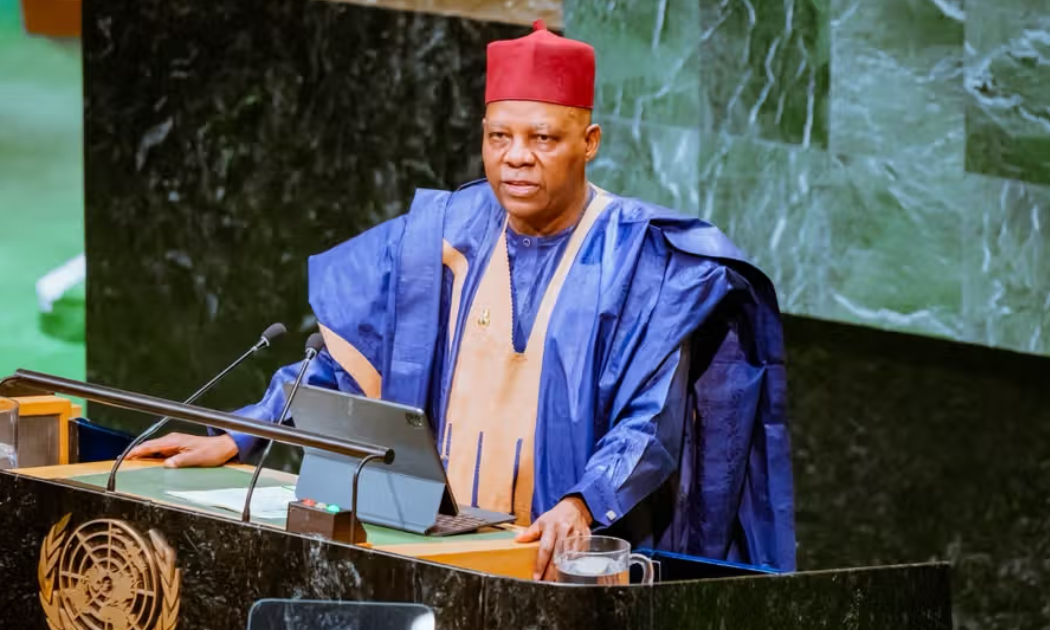
Vice-President Kashim Shettima, who spoke on the country’s
behalf on Thursday in New York, expressed concern over a stagnancy in reforms.
Speaking on the need for African representation in the UN
security council, climate financing, and technological transfer, Shettima
harped on the benefits of a unified front through a recommitted era of global
multilateralism.
He urged international partners to dismantle what he termed
a “unilateral aggression” and to resurrect the foundational principles of the
UN charter.
Here are key takeaways from his speech.
AGAIN, NIGERIA DEMANDS UNSC SEAT
Nigeria’s push for a permanent seat on the UN security
council is hardly new.
Shettima tied the opening parts of his remarks to Nigeria’s
long-standing Africa-centred foreign policy, which places the country’s
diplomatic efforts within the broader interests of the continent.
The common position of the African Union (AU) on the UN
security council reform, known as “The Ezulwini Consensus”, is based on the
communiqué it adopted in Addis Ababa in March 2005.
It calls for Africa to have “not less than two permanent
seats” and five non-permanent seats on the council. Currently, the continent
has no permanent seats but has three non-permanent seats on the council.
“Nigeria demands, in accordance with the Ezulwini Consensus
and the CFTA Declaration, at least two permanent seats for Africa, with all the
rights and responsibilities of permanent membership, including the veto, for as
long as it exists, and five non-permanent seats in total,” Shettima said.
“The authority to speak for humanity carries an obligation
to represent it. Nigeria stands ready to assume greater responsibility on the
strength of obligations honoured and sacrifices made over decades in the
service of peace.
“From Liberia and Sierra Leone to Darfur, Mali, and The
Gambia, we have committed personnel and resources when international solidarity
required action.”
The vice-president added that the country has also worked to
advance mediation, democratic governance, counter-terrorism, and maritime
security through ECOWAS, the AU, and its Gulf of Guinea partnerships.
Shettima noted that a reformed, inclusive, and effective UN
would be indispensable to the “peaceful, just, and sustainable world that
future generations deserve”.
FINANCIAL REFORMS
One of the changes Shettima sought was a restructure in the
architecture of climate financing.
He rejected a trade-off between climate action and
industrialisation, and said it was necessary for developing countries to
industrialise, eradicate poverty, and expand energy access through low-carbon
pathways supported by technology transfer, capacity building, and climate
finance.
“Africa contributes less than four per cent of the
greenhouse gas emissions, yet we have disproportionate consequences,” Shettima
said.
He said Nigeria’s energy transition plan sets a net-zero
emissions target by 2060 while expanding access to affordable, reliable, and
sustainable energy.
Shettima, however, noted that climate finance must be
governed by equity and shared responsibility, rather than charity, with
international commitments translated into accessible, predictable, and
adequately funded mechanisms that enable developing countries to pursue climate
action without compromising development objectives.
He said Nigeria remains committed to the Paris Agreement and
an equitable energy transition that reflects historical responsibility and
capacity while protecting people’s right to development.
The vice-president also frowned at what he said were
existing “obstacles” for developing countries to access development financing,
noting that resources are often dedicated to debt servicing at the expense of
education, healthcare, and infrastructure.
“Nigeria therefore calls for reform of the international
financial architecture, wider access to concessional financing, and debt
sustainability frameworks that recognise developmental needs,” he said.
“We also support innovative financing through private
capital, blended finance, South-South cooperation, and strategic partnerships
for sustainable development, climate adaptation, and resilient infrastructure.”
SECURITY COOPERATION AND GLOBAL PEACE
One key point of Shettima’s address was the need for
stronger international security cooperation to tackle insecurity in the Sahel.
He noted that development would remain stunted if violence
continues to ravage the region.
“Our common security, therefore, demands cooperation equal
to the reach of the trade before us,” he said.
“We must exchange intelligence, strengthen institutional
capacity, interrupt the financing of violence, and prevent weapons from
crossing borders that our responses too often fail to cross.
“The turmoil in the Sahel illustrates how insecurity in one
territory can imperil its neighbours, displace populations, and frustrate
commands, regional integration, and democratic governance.
“As a founding member of ECOWAS, Nigeria upholds regional
solidarity and African leadership in resolving these challenges, reinforced by
principal international partnerships.
“No country can claim lasting safety while the forces
capable of destabilising it retain sanctuary, resources and recruits
elsewhere.”
Shettima also called for the peaceful settlement of disputes
in Sudan and other war-torn countries.
He said all parties must uphold international humanitarian
and human rights law, protect civilians, and facilitate humanitarian access,
noting that negotiated settlements must respect sovereignty and territorial
integrity.
NIGERIA PUSHES BACK AGAINST AI FEAR-MONGERING
The subject of technological advancements also formed part
of Shettima’s address.
The vice-president said Nigerian would not surrender its
technological future to paranoia.
“An invention can be destructive or beneficial depending on
the purpose it serves and the judgment of those who use it. A knife can take
life in the hands of an assailant and can save one in the hands of a surgeon,”
he said.
“We can deploy artificial intelligence to wage war or use it
to transform healthcare, agriculture, governance, and economic productivity.”
He noted that much of the anxiety surrounding AI “reflects
the distrust we have allowed to grow amongst us”.
Nigeria’s position on AI comes at a time when several
technology leaders, including Bill Gates, have raised concerns over the rapid
development of the technology, although some Silicon Valley leaders have
rejected the idea that its advancement should be viewed primarily through the
lens of fear.
Shettima said Nigeria is investing in digital public
infrastructure, broadband connectivity, innovation systems, research
institutions, and technology entrepreneurship.
“We invite the world to work with our inventive,
resourceful, and enterprising young people to direct AI towards humanity’s
advancement rather than its destruction,” he said.
AFRICA AS PARTNER
The vice-president ended his nearly 15-minute address with
positioning Africa as ready for the future.
“Our resilience, our ingenuity, our useful population, our
natural wealth, and our expanding markets can make us a major driver of global
growth in this century,” he said.
“The African Continental Free Trade Area offers exceptional
scope to deepen regional integration, accelerate industrialisation, and
strengthen our place in global value chains.”
Shettima noted that developing countries must be recognised
as indispensable partners, whose contributions to global solutions and shared
prosperity extend far beyond their need for assistance.
He reiterated Nigeria’s commitment to cooperation, dialogue,
and partnership, urging the UN and international partners to engage in clear
actions after the general debate.
Click to signup for FREE news updates, latest information and hottest gists everyday
Advertise on NOP NIGERIA to reach thousands of our daily users



AFC supports ₦729 billion series 2 bonds to advance Nigeria’s power sector reforms

AFCON 2027Q: Keep crying – Nwabali fires back at critics after Super Eagles return

Nigeria’s fiscal-monetary pact faces a four-number test

Extradited Nigerian national pleads guilty to $2.5m sextortion and romance scam in US

FG working to announce new minimum wage – Shoretire

Polygamous Ghanaian man shares maternity photos with his two wives
You have no right to govern other countries – Brazil’s President Lula slams Trump

“I’m Not Acting President” – Akpabio Clarifies Amid Tinubu, Shettima’s Absence
-

 News2 days ago
AFC supports ₦729 billion series 2 bonds to advance Nigeria’s power sector reforms
- Breaking2 days ago
AFCON 2027Q: Keep crying – Nwabali fires back at critics after Super Eagles return
- Business3 days ago
Nigeria’s fiscal-monetary pact faces a four-number test
- Special Reports3 days ago
Extradited Nigerian national pleads guilty to $2.5m sextortion and romance scam in US