News
Why Nigeria needs citizens with courage – Apo Six Lawyer Nzelu


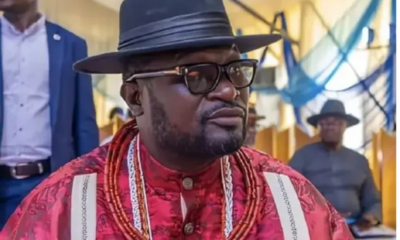
Prominent Lawyer, Amobi Nzelu, has said that Nigeria’s democratic challenges are rooted not only in bad leadership but also in the growing inability of citizens to resist inducement, question authority and demand accountability.
Nzelu, who led the legal battle on behalf of the families of the six young Nigerians killed by police officers in Abuja in 2005, said Nigerian institutions would continue to fail unless citizens developed the courage to challenge wrongdoing and hold those in positions of authority accountable. Blueprint reports
The killings, popularly known as the Apo Six, triggered a judicial inquiry and a prolonged criminal trial that attracted widespread public attention. Two policemen were eventually sentenced to death in 2017, while other defendants were discharged and acquitted.
Speaking during an interview with journalists at his residence in Abuja, Nzelu said his experience in the Apo Six case reinforced his conviction that individuals must be prepared to stand up against powerful institutions, even when doing so comes with personal risks.
“You pray to God Almighty to give you the grace to say no to evil,” he said, quoting Proverbs 1:10: “If they entice you, consent thou not.”
‘Citizens must learn to say no’
According to the veteran barrister, one of the greatest threats to Nigeria’s democracy is the willingness of citizens to compromise their principles in exchange for financial or material benefits.
He argued that while political leaders and public officials must be held responsible for their actions, citizens also have a role to play in determining the quality of governance they receive.
Nzelu said citizens must develop the courage to reject inducements and resist attempts to make them participants in wrongdoing.
For him, the ability to say no to evil remains one of the most important safeguards against the abuse of power.
He said his decades of legal practice had shown him that justice could not always be secured simply because the law was on the side of the victim.
Rather, he said, it often required individuals who were willing to persist, ask uncomfortable questions and challenge institutions with greater power and resources.
Financial inducement threatening accountability
Nzelu also expressed concern over the increasing influence of financial inducements in Nigerian society, saying the country’s economic difficulties had made it more difficult for ordinary citizens to resist offers of money.
He noted that many Nigerians were struggling to meet basic needs, creating an environment where financial incentives could easily compromise people’s decisions.
The lawyer, however, maintained that economic hardship should not completely extinguish the people’s responsibility to demand accountability.
He argued that allowing inducements to determine public decisions would only deepen the problems confronting the country and make institutions increasingly vulnerable to manipulation.
According to him, the consequence is a cycle in which citizens complain about bad governance while simultaneously accepting practices that enable the same system to continue.
Nzelu raises concern over judiciary
The veteran lawyer was particularly critical of the judiciary, expressing concern that corruption and financial considerations had contributed to declining public confidence in the justice system.
He stressed, however, that his criticism should not be interpreted as an indictment of every judicial officer.
Nzelu acknowledged that there were still judges and other judicial officials committed to upholding the law and delivering justice.
His concern, he said, was the broader perception that financial considerations could influence access to justice and the outcome of cases.
He warned that once citizens lose confidence in the judiciary, the damage extends beyond individual cases and threatens the credibility of the entire democratic system.
‘Nigeria should ask questions’
Nzelu also questioned the level of spending associated with Nigeria’s political institutions, particularly the legislature, against the backdrop of widespread economic hardship.
He argued that public officials should be required to explain how public resources are spent, stressing that accountability should not be regarded as an attack on government institutions.
For him, citizens have a legitimate right to ask questions whenever public expenditure appears inconsistent with the economic realities facing the majority of Nigerians.
“When somebody is spending 50 times above the person’s income, Nigeria should be able to ask questions,” he said.
He said unexplained wealth and extravagant spending should not automatically be accepted as signs of success or political influence.
Instead, Nigerians should develop a culture of questioning where individuals in positions of authority are expected to account for their wealth and expenditure.
Apo Six battle shaped his conviction
Nzelu’s position is shaped significantly by his experience in the Apo Six case, in which he challenged the police account surrounding the deaths and represented the families through the judicial inquiry and subsequent legal proceedings.
The case became one of the most prominent examples of citizens challenging alleged abuses by security personnel and seeking justice through Nigeria’s legal system.
For Nzelu, the long battle demonstrated that securing justice can require persistence, particularly when ordinary citizens are confronting powerful state institutions.
He said the experience strengthened his belief that lawyers, citizens and civil society must not retreat whenever institutions are accused of wrongdoing.
Rather, he said, they must insist on due process and accountability.
Ethnicity, religion should not divide Nigerians
The veteran lawyer also warned Nigerians against allowing ethnic and religious differences to distract them from the common challenges confronting the country.
He argued that ordinary Nigerians, regardless of their ethnic or religious backgrounds, experience many of the same economic and social difficulties.
“All of us go to the same market,” he said. “Is that market for Yoruba? Is that market for Igbo?”
He said Nigerians should therefore look beyond ethnic and religious identities when confronting issues of corruption, poverty, insecurity and poor governance.
According to him, political and social divisions often make it easier for citizens to overlook problems that affect everyone.
‘Hope lies in our resolve to say no’
Nzelu said the responsibility for Nigeria’s future could not be left entirely to politicians or government institutions.
“The hope lies in our resolve to say no and to ask questions,” he said.
He maintained that democracy could only thrive when citizens were prepared to demand explanations from those entrusted with public resources and authority.
For the veteran lawyer, Nigeria’s democratic renewal will therefore require more than periodic elections.
It will require a citizenry prepared to reject inducements, challenge abuses of power, question unexplained wealth and insist that public institutions operate in the interest of the people.
Drawing from his experience in the Apo Six case, Nzelu said the struggle for justice may be difficult and prolonged, but citizens must not surrender their responsibility to speak against wrongdoing.
His message is ultimately a call for greater civic courage: Nigerians must be willing to say no to evil, no to inducement and no to the normalisation of impunity if the country’s democracy is to regain public confidence.



2027: Act fast, Umahi hates Niger Delta – APC’s Ayiri Emami to Tinubu

Nigeria ’s PPP successes offer blueprint for Africa – ICRC DG Ewalefoh

NDC Taraba crisis deepens as legal adviser rejects chairman’s removal

Model Brooks Nader gives bizarre reason for exposing bare body in presence of her dad

DisCos’ billing, collection failures undermining Nigeria’s power market – Experts

Kebbi APC challenges ADC over Malami’s alleged 48 properties

âI cannot be disrespectedâ â American rapper, Megan Thee Stallion opens up about split with NBA star, Klay Thompson

Bishop killed in South Africa, consulate demands justice
-

 Politics2 days ago
2027: Act fast, Umahi hates Niger Delta – APC’s Ayiri Emami to Tinubu
- News3 days ago
Nigeria ’s PPP successes offer blueprint for Africa – ICRC DG Ewalefoh
- Politics3 days ago
NDC Taraba crisis deepens as legal adviser rejects chairman’s removal
- Special Reports2 days ago
Model Brooks Nader gives bizarre reason for exposing bare body in presence of her dad