News
Seplat Bets Big on Record-Breaking 2026 As H1 Net Profits Sextuple, Output Surpasses FY 2025

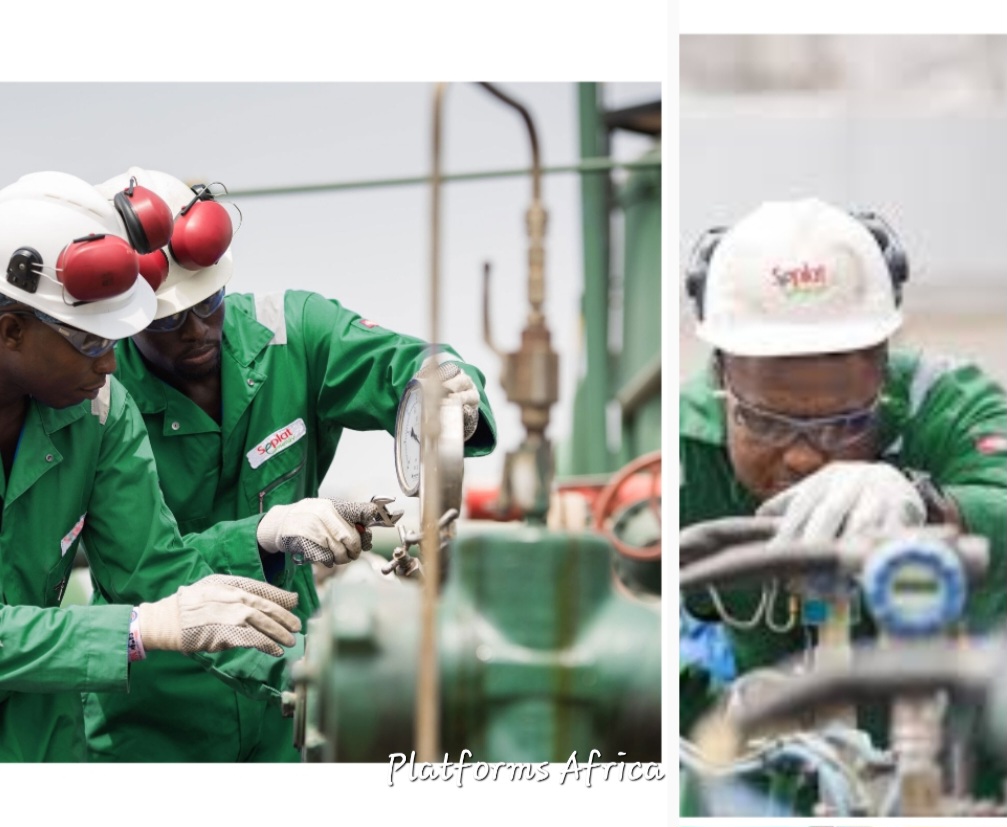
● As Hormuz Narrows, Nigeria Gets Its Moment, Effiong Okon in his first address as CEO, links Nigeria’s energy opportunity to global chokepoint
With half of 2026 already exceeding last year’s full-year average production, and net profit up nearly sixfold in the first half, Effiong Okon, Seplat Energy Plc’s new Chief Executive Officer, in his maiden address and on his first day in the role declared that the company is on track to beat its own record 2025 performance, even as growth normalises from last year’s acquisition-driven surge.
The new CEO made the declaration while delivering the keynote address at the opening ceremony of the 49th Nigeria Annual International Conference and Exhibition (NAICE 2026), organised by the Society of Petroleum Engineers (SPE) Nigeria Council in Lagos, themed “Thriving in the Evolving Global Energy Landscape: Collaborative Growth and Resilience.”
He aligned Seplat’s turnaround directly with NNPCL’s national ambition of 3 million barrels per day and 12 Bscf/d by 2030, framing the company’s 2025 result not as a one-off, but as a template for Nigeria’s broader energy strategy.
Okon anchored his keynote on Seplat’s 2025 turnaround: average working interest production of 131,506 barrels of oil equivalent per day, up 148 per cent year-on-year, driven largely by the first full-year contribution of assets acquired from ExxonMobil.
He also pointed to Seplat’s restoration of 49 idle offshore wells, which added 48,600 barrels of oil equivalent per day in gross production capacity, and to the company closing the year with a combined 2P and 2C resource base of roughly 2.49 billion barrels of oil equivalent.
On gas, Okon said Seplat processed 172 million standard cubic feet per day of net working-interest gas in 2025 and now supplies up to 30 per cent of the gas feeding Nigeria’s power grid, via its Oben, Sapele and ANOH facilities — a combined capacity of 855 million standard cubic feet per day.
He noted that the ANOH plant, which reached first gas in January 2026, faced a condensate-evacuation bottleneck on the Trans Niger Pipeline that capped output near half of its 300 MMscfd design capacity through the first quarter, even as it touched a peak processing rate of about 193 MMscfd by end-April.
The Seplat CEO described energy security not as an abstract policy debate but as the foundation economies stand on.
Citing Lloyd’s List Intelligence figures reported by CNBC, Okon noted that vessel transits through the Strait of Hormuz fell from 157 to just 53 in the week through 20 July 2026, with tanker and gas-carrier movements dropping from 90 to 30 over the same period.
He added that Kpler data similarly showed daily crossings collapsing from more than 20 before 15 July to single digits the following day.
He cautioned, referencing UNCTAD, that the disruption’s full economic impact may not be felt until the second half of 2026, as rising transport, insurance, fuel and supply-chain costs work through the global economy.
He noted that the Strait of Hormuz’s importance extends beyond crude and LNG to fertiliser trade, with knock-on risks for food production and prices.
On the supply side, Okon cited the IEA’s July 2026 Oil Market Report, which showed global oil supply rebounding by 4.1 million barrels per day in June to 98.8 million barrels per day as Hormuz flows partially resumed, though output remained roughly 9.4 million barrels per day below pre-war levels, with refined product markets staying tight even as crude flows recovered.
READ ALSO
Billionaire Indimi, Twin Daughters Battle In Court Over $43.4m Oriental Energy Dividends
‘No Going Back,’ Nigeria Rocks On With Push For Africa’s Refining Hub Crown
U-Turn: Dangote Resumes Naira Petrol Sales, Hikes Price By N140/Litre
‘Bullish,’ How Seplat Raked In $840.7 Million In Three Months
Elumelu’s Heirs Energies, NNPC, Others; Losers, Shockers From Nigeria Oil Bid Rounds
He tied this global backdrop directly to Nigeria’s opportunity, arguing the country must answer the question of “who can deliver energy reliably when the system is stressed” by improving uptime, securing export routes and deepening gas infrastructure.
Okon also pointed to a structural shift in global energy demand: the rise of artificial intelligence and data centres.
He cited IEA projections that global electricity supply for data-centre demand could more than double, from 460 terawatt-hours in 2024 to over 1,000 terawatt-hours by 2030, emphasising that Nigeria’s competitiveness in fintech, AI and digital services now depends as much on power supply as on digital policy.
Framing his central thesis of “energy addition, not energy subtraction,” Okon put Nigeria’s current output in national context, citing NUPRC figures showing the country produced about 554.4 million barrels of crude oil and condensate in 2025, at an average of roughly 1.63 million barrels per day, a base he said still leaves room for improvement through reduced losses, reactivated idle capacity and faster project cycles.
NOP NIGERIA












Zenith Bank Charts New Path to Scale Nigeria’s $6.1bn Non-Oil Export Market

FG targeting 6,500MW of power supply by December, says Tegbe

Oluwo urges Tinubu to grant Nnamdi Kanu presidential amnesty

‘Win With Tinubu’ team to meet Ododo, targets 239 wards in Kogi

President Tinubu condemns mass abduction in Niger state, orders immediate rescue operation

ADC challenges Tinubu to clarify ‘all is fair in politics’ remark

MTN Nigeria emerges as key driver of Group’s first half 2026 growth

Community resilience: Yobe SEMA, UNDP train volunteer security personnel, others
-

 Finance3 days ago
Zenith Bank Charts New Path to Scale Nigeria’s $6.1bn Non-Oil Export Market
- Breaking2 days ago
FG targeting 6,500MW of power supply by December, says Tegbe
- News2 days ago
Oluwo urges Tinubu to grant Nnamdi Kanu presidential amnesty
- News2 days ago
‘Win With Tinubu’ team to meet Ododo, targets 239 wards in Kogi