Society
Presidency, Atiku Clash Over Fuel Subsidy Promise


…I’ll Remove Subsidy If Elected President — Atiku
…Atiku’s Plan Retrogressive, Will Cripple Economy — Presidency
— Ex-VP Confused, A Voodoo Economist—Wike
The presidency and former Vice President Atiku Abubakar have clashed over his promise to restore fuel subsidy if elected president.
The Federal Government described the proposal as regressive and questioned how it would be funded under Nigeria’s current petroleum-sector structure.
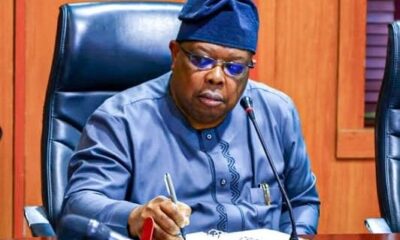
The dispute was further escalated on Thursday by the Minister of the Federal Capital Territory, Nyesom Wike, who slammed Atiku for abandoning his earlier position on subsidy removal and described him as a “voodoo economist.”
The Presidency, in a statement by the Special Adviser to the President on Information and Strategy, Bayo Onanuga, said Atiku’s proposal amounted to a return to a subsidy regime that had been dismantled under the Petroleum Industry Act.
Onanuga noted that Atiku had supported subsidy removal but now changed his position five months before the election in an alleged attempt to win political support.
In an interview on Wednesday, Atiku said the current administration failed to account for the funds saved from the removal of petrol subsidy.
“I did not oppose the removal of the oil subsidy, but where is the money? Where did it go? It was intended to reduce poverty and help children attend school. Where is the money now? It seems they are just stealing it,” Atiku said in Hausa.
“If elected, I will bring back the oil subsidy, and whoever stole the money must refund it.”
Atiku said subsidy removal could have been justified if the savings had been channelled into development projects.
“The government successfully removed the subsidy, but we do not know where the money went. If they had used the money for development, to solve security problems, for education, and to create opportunities for the youth, it would be different. If elected, I can remove the subsidy and use the money to do all these properly,” he stated.
Reacting, the presidency said: “We respect Alhaji Atiku Abubakar’s constitutional right to propose alternative policies, to seek the support of Nigerians and recant a major policy prescription,” the presidency said.
“However, Nigerians also deserve to understand what the proposed restoration of subsidy would actually mean, how it would be funded, and whether it is compatible with the legal and structural changes that have taken place in the petroleum sector.”
The presidency argued that the subsidy was not simply money kept in government coffers for the purpose of reducing petrol prices.
It described the former arrangement as the Nigerian National Petroleum Corporation’s sale of petrol below its acquisition cost, with government absorbing the resulting losses.
“It is the massive discount the NNPC offered the Nigerian government: selling fuel it bought at N100 at N50 at the pump, leading to under-recovery of costs and massive losses,” the statement said.
It also rejected Atiku’s claim that the removal of subsidy had created N30trn in savings, saying, “no N30 trillion subsidy windfall or savings exists anywhere except in his imagination.”
According to the presidency, the petrol subsidy regime had already been dismantled under the Petroleum Industry Act, which provided for its removal by the end of June 2023.
It said President Bola Tinubu only brought the removal forward by several weeks to prevent further financial losses.
The presidency noted that any attempt to restore the former arrangement would therefore require more than an announcement by a future government, adding that it would require a new legal, fiscal and administrative framework.
It further questioned what exactly would be subsidised under the current petroleum market, following the growth of domestic refining capacity and the emergence of private refineries.
“The Dangote Refinery would not have kickstarted production for local consumption were the subsidy regime operative,” the statement said.
It argued that restoring the former arrangement could undermine local refining and expose smaller domestic refineries to financial pressure, with possible consequences for employment and foreign exchange.
The presidency also pointed to the shift from dependence on imported petrol to domestic refining, saying Nigeria was increasingly able to process crude locally and supply the domestic market.



FG targeting 6,500MW of power supply by December, says Tegbe

ADC challenges Tinubu to clarify ‘all is fair in politics’ remark

Oluwo urges Tinubu to grant Nnamdi Kanu presidential amnesty

BBNaija: Biggie gives Flora secret mission to make Aikou fall in love

‘Win With Tinubu’ team to meet Ododo, targets 239 wards in Kogi

President Tinubu condemns mass abduction in Niger state, orders immediate rescue operation

MTN Nigeria emerges as key driver of Group’s first half 2026 growth

Kogi safety professionals warn truck operators, move to enforce regulation compliance
-

 Breaking2 days ago
FG targeting 6,500MW of power supply by December, says Tegbe
- Politics3 days ago
ADC challenges Tinubu to clarify ‘all is fair in politics’ remark
- News3 days ago
Oluwo urges Tinubu to grant Nnamdi Kanu presidential amnesty
- Breaking3 days ago
BBNaija: Biggie gives Flora secret mission to make Aikou fall in love