News
Nigeria: 650 building collapse, 1,600 deaths recorded since 1974 – FG

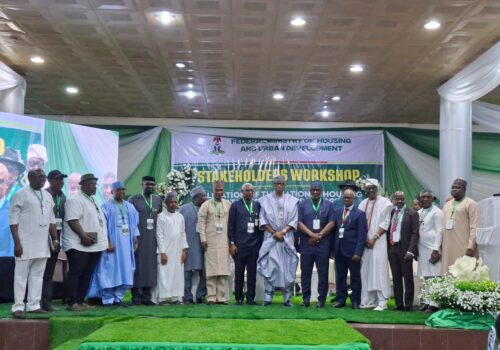

Minister of Housing and Urban Development, Engr. Muttaqha Rabe Darma, has demanded for the regulation of the housing sector in order to curb all forms of fraud and housing deficit experienced in the sector.
He stated this Tuesday July 28, 2026 in Abuja, during a stakeholders’ validation workshop on the National Housing Data Programme Report and the Regulation of the Built Environment in the Housing Sector.
Speaking at the opening ceremony of the three-day stakeholders workshop, Darma said the housing sector contributes a large percentage of the countries Gross Domestic Produce (GDP) and should not be an all-comers affair.
He said Dubai created wealth by regulating the housing sector and should be emulated by Nigeria.
He lamented that over 650 building collapses and over 1,600 deaths have been recorded in the country since 1974 as a result of lack regulation in the housing sector.
Regulation issues
He said: “After the rebasing of our accounts, real estate services alone account for about 13.4 per cent of Nigeria’s GDP, roughly 41 trillion naira. It is our third largest sector, ahead of telecommunications and ahead of crude oil. With construction added, the two crossed 77 trillion naira in 2025.
“Now the hard question. What does government earn from that, and what protection does the ordinary Nigerian get? Almost nothing. We regulated banking and got a stable financial system. We regulated telecommunications and turned fewer than half a million telephone lines into over 200 million. We regulated petroleum and power. We never regulated housing. So our biggest sector is still the one where a man can print a brochure in the morning, collect a widow’s savings by afternoon, and vanish before nightfall.
“Dubai has no oil worth the name. What it built instead was a rule book. In 2007 it made escrow accounts compulsory, so money paid for an unbuilt house sits in a supervised account and is released only as the building rises. It created RERA to license every developer and every agent, and it publishes the data. In 2025 Dubai recorded over 270,000 property transactions worth 917 billion dirhams, about 250 billion dollars, in one city, in one year.
“Dubai is smaller than Kano. The difference is not money. The difference is trust, and trust is manufactured by regulation.
“Since 1974 Nigeria has recorded more than 650 building collapses and over 1,600 deaths. Those are not figures; they are funerals. Almost every one of those buildings had a designer, a builder and an approving officer. In most cases nobody was licensed and nobody was punished.
“Six million Nigerians contribute to the National Housing Fund. The FMBN collects between 120 and 150 billion naira from them yearly and books fewer than 500 mortgages. Our mortgage-to-GDP ratio is between 0.02 and 0.07 per cent. South Africa is 30. Britain is 70. That is not poverty; that is bad plumbing.”
Housing deficit issues
He added: “The National Housing and Built Environment Regulation Policy stands on six pillars: licensing of developers and agents; escrow protection for buyers’ money; professional registration and construction quality; land administration and land-value capture; urban renewal without displacement; and a national data observatory. It proposes a National Housing Industry Regulatory Commission ranking with the NCC and NERC, and a federal framework the states adopt as their own.
“The National Mortgage Industry Policy establishes the National Housing Finance Authority, reforms the FMBN, opens the NHF to traders, artisans and drivers from 5,000 naira a month, and builds a proper diaspora window on the 20 billion dollars our people send home each year.
“For twenty years, we have quarrelled over whether the deficit is 15, 20 or 28 million units. No serious investor finances an argument. Using the World Bank Adequate Housing Index and the UN-Habitat Household Crowding Index, our Technical Committee puts the core deficit at about 15 million units, with the North-West and North-East under heaviest pressure. The methodology is in your folders. Attack it. If it survives this room, the quarrel is over.
“Regulation is not popular work. It makes enemies of everybody who profits from confusion, and some of them are in this room. I welcome them, because I would rather argue with you here than read about you in a tribunal later.
“Tonight, somewhere in this country, a young couple will hand over everything they own for a house that will never be built. A family will sleep under a slab nobody tested. A civil servant who has paid into the NHF for twenty-five years will retire into a rented room. We in this hall can make those things rare, and then make them strange.
“Sixty-six years after independence, let this be the generation that turned Nigerian housing from a gamble into an industry. Speak freely. Disagree with me openly. Correct me here, where it costs nothing, rather than in Council, where it costs the country.”
Permanent Secretary
Also speaking, the Permanent Secretary Dr. Shuaib Belgore, said the key stakeholders from the Federal and State Governments, professional and regulatory bodies, development partners, financial institutions, academia, the private sector and other relevant institutions will validate two critical national initiatives that are central to the transformation of Nigeria’s housing sector.
He said: “The first is the National Housing Data Programme, which seeks to establish a credible, reliable and sustainable national housing data ecosystem that will support evidence-based policymaking, improve planning, strengthen investment decisions and enhance the monitoring and evaluation of housing interventions across the country.
“The second is the Regulation of the Built Environment, which seeks to strengthen regulatory oversight, promote compliance with established standards, improve professionalism within the construction industry and address the persistent challenge of building collapse through coordinated institutional reforms.
“As we are all aware, Nigeria’s housing sector has for many years been challenged by fragmented data systems, inadequate coordination among institutions and weak regulatory enforcement. These limitations have constrained effective planning, reduced investor confidence and affected the overall quality, safety and sustainability of housing development nationwide.
“Recognising these challenges, the Ministry inaugurated the 13-member National Housing Data Steering Committee, which I have the privilege of chairing, alongside the 20-member Technical Committee in August 2024 to develop a sustainable framework for the establishment of the National Housing Data Centre.
“Following months of extensive technical work and stakeholder consultations, the Technical Committee, under the leadership of Dr. Taofeeq Olatinwo, submitted its Final Report in December 2025, which was accepted by the Honourable Minister as a major intellectual, technical and institutional milestone for the housing sector.
“The Committee’s work has provided Nigeria with a scientifically derived estimate of the national housing deficit, developed a comprehensive National Housing Data Framework and Implementation Strategy, and laid the foundation for the establishment of the National Housing Data Centre.
“The short-term recommendation to domicile the Programme within the Planning, Research and Statistics Department has already been implemented, while the Concept Note for the establishment of a Special Purpose Vehicle as the long-term institutional framework has been approved. An Implementation Committee has equally been inaugurated to drive the operationalisation of these recommendations.
“In addition, following the increasing incidence of building collapse across the country, the Honourable Minister constituted a Ministerial Task Team to review the underlying causes and recommend comprehensive reforms aimed at strengthening the regulation of the built environment. The recommendations arising from that assignment, together with other ongoing regulatory initiatives of the Ministry, form an important component of our deliberations during this workshop.”
House of Reps Chair
In his goodwill message, the Chairman, House of Representatives Committee on Regional Planning and Urban Development, Hon. Dr. Awaji-Inombek Abiante, stressed the need for reliable, homegrown housing data to tackle Nigeria’s housing challenges, noting that effective planning and meaningful reforms can only be built on accurate information.
While stating that housing reforms must improve the lives of all Nigerians, not just a privileged few, he reaffirmed the National Assembly’s support for initiatives that will strengthen housing data, promote orderly urban development and drive lasting reforms across the housing sector.
Mortgage Bank boss
On his part, the Managing Director, Federal Mortgage Bank of Nigeria (FMBN), Shehu Usman Osidi, disclosed that the Bank has developed the National Mortgage Registry, a central digital repository for mortgage transactions across the country which is now ready for deployment following ongoing stakeholder engagement, data collection, cleansing and validation.
According to him, the registry will enhance transparency, strengthen risk management and improve confidence in Nigeria’s mortgage system, while its successful implementation will depend on sustained collaboration among government institutions, financial institutions, developers and other stakeholders.



Oluwo urges Tinubu to grant Nnamdi Kanu presidential amnesty

FG targeting 6,500MW of power supply by December, says Tegbe

ADC challenges Tinubu to clarify ‘all is fair in politics’ remark

MTN Nigeria emerges as key driver of Group’s first half 2026 growth

BBNaija: Biggie gives Flora secret mission to make Aikou fall in love

‘Win With Tinubu’ team to meet Ododo, targets 239 wards in Kogi

President Tinubu condemns mass abduction in Niger state, orders immediate rescue operation

Malami Inaugurates 600-Member ADC Campaign Council in Kebbi
-

 News3 days ago
Oluwo urges Tinubu to grant Nnamdi Kanu presidential amnesty
- Breaking2 days ago
FG targeting 6,500MW of power supply by December, says Tegbe
- Politics3 days ago
ADC challenges Tinubu to clarify ‘all is fair in politics’ remark
- News2 days ago
MTN Nigeria emerges as key driver of Group’s first half 2026 growth