News
Jigawa community holds three-day special prayer for rain

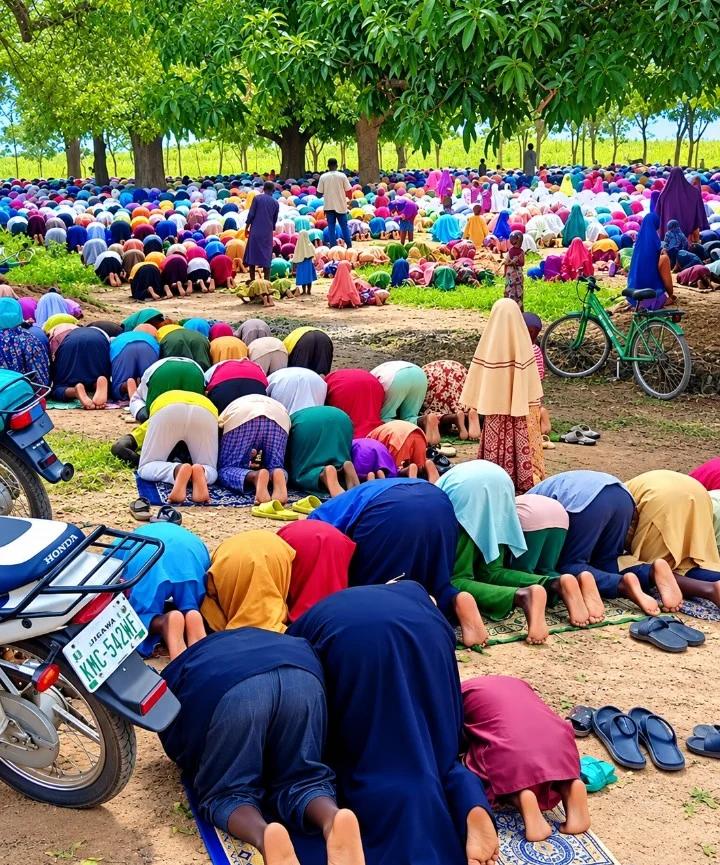

Residents of Basirka community in Gwaram Local Government Area of Jigawa State have embarked on a three-day special prayer seeking divine intervention over the prolonged absence of rainfall in the area.
The prayer, which commenced on Saturday and continued through Sunday before climaxing on Monday, attracted hundreds of residents who gathered at the town’s Eid prayer ground to appeal to Almighty Allah for rainfall.
The development followed growing concerns among farmers in the community over the impact of the prolonged dry spell on crops, livestock and other agricultural activities. Blueprint reports
Residents said the absence of adequate rainfall had become increasingly worrying as crops planted during the farming season were beginning to show signs of stress and deterioration.
Farmers fear loss of crops
For many residents of Basirka, the current situation is particularly troubling because a large proportion of the population depends on agriculture for food and livelihood.
The prolonged dry spell has raised fears that farmers could lose their crops if meaningful rainfall does not return soon.
A 65-year-old farmer, Ibrahim Musa Dankoli, said his maize and millet farms had already begun suffering from the lack of rain.
According to him, the situation had left farmers with limited options, particularly those who depend entirely on rain-fed agriculture.
“We have not had good rainfall for weeks, and our crops have started burning. We have no power except to return to Allah for help,” Dankoli said after participating in the prayer.
Another resident, Haruna Aliyu Basirka, said the interruption in rainfall had created considerable anxiety among farmers across the area.
He explained that the community was concerned because the dry spell had occurred during an important period of the agricultural season when farmers needed regular rainfall to sustain their crops.
“We are worried because this is the middle of the farming season but the rains have seized. That is why we came out today to pray together for Allah’s mercy,” Aliyu said.
Community turns to Salatul Istisqa
The special prayer is known in Islamic tradition as Salatul Istisqa, a prayer performed by Muslims to seek rainfall during periods of drought or severe shortage of water.
The exercise in Basirka was led by the town’s Chief Imam, Sheikh Sanunu Basirka, who also delivered a sermon after the two-rak’ah prayer on Monday.
The Chief Imam urged residents to use the period of hardship as an opportunity for spiritual reflection, repentance and increased devotion to Allah.
He stressed that the prayer should not be regarded as a one-day activity, noting that the community had deliberately sustained the exercise over three consecutive days.
Sanunu said residents had also been encouraged to observe a voluntary fast on Monday as part of their efforts to seek divine intervention.
“We observed this prayer since Saturday, Sunday, and we have done it again today, Monday. We also urged the people to observe a voluntary fast today, Monday, to seek intervention from Almighty Allah,” he said.
He added that the gathering provided an opportunity for residents to collectively repent and seek forgiveness while praying for rain that would restore agricultural activities and bring relief to the community.
“We have gathered here today at the Eid ground to sincerely repent and ask Allah to forgive us and bless us with abundant rainfall that will bring mercy and prosperity to our land,” the cleric added.
Cleric urges repentance, charity
In his sermon, the Chief Imam further encouraged residents to intensify prayers, give charity and avoid actions believed to attract divine displeasure.
He described the drought as a test and urged members of the community not to lose hope despite the difficult circumstances confronting them.
Sanunu reminded the residents of the Islamic teaching that repentance and seeking forgiveness are associated with divine mercy and relief.
He therefore appealed to the people to return to Allah with sincerity while continuing to pray for beneficial rainfall.
The cleric’s message also appeared to reinforce the communal nature of the exercise, as residents from different age groups and backgrounds gathered together at the Eid ground to participate in the prayers.
Men, women, youths join prayer
The prayer attracted a broad cross-section of the Basirka community and neighbouring settlements.
Farmers, Islamic scholars, elderly residents, women and youths were among those who attended the gathering.
Men, women and children were seen at the Eid ground under the scorching sun, with participants raising their hands in supplication and asking for divine mercy.
The turnout reflected the seriousness with which residents viewed the situation, particularly given the importance of rainfall to agriculture and livestock in the predominantly rural community.
A youth leader in the town, Malam Sulaiman Adamu Basirka, said the decision to organise the special prayer was driven by the community’s observation of changing weather conditions and the effect of the dry spell on their livelihoods.
He said residents had decided to come together regardless of age or gender to pray for rainfall that would benefit both humans and animals.
“We came out here as one community, old and young, men and women, to beg Allah to send us beneficial rain that will save our farms and provide water for our animals,” Sulaiman said.
Unusual rainfall pattern raises concern
The development in Basirka comes against the backdrop of varying rainfall patterns across different parts of Nigeria.
While some parts of the southern region have experienced episodes of heavy rainfall, resulting in flooding and other weather-related challenges, some communities in the northern part of the country have continued to express concern over inadequate or irregular rainfall.
Farmers in parts of the North have increasingly become dependent on the timing and distribution of rainfall because many rural communities lack access to reliable irrigation facilities.
In such communities, prolonged gaps between rainfall can have immediate consequences for crops, particularly during critical stages of their growth.
Jigawa, like several other states in northern Nigeria, has a large rural population involved in farming, making rainfall a critical component of the local economy and food supply.
The situation in Basirka has therefore heightened concern among residents who fear that continued dry conditions could worsen food insecurity and place additional financial pressure on farming households.
Hope for relief
Despite the difficulties caused by the dry spell, residents who participated in the three-day prayer expressed hope that rainfall would return and rescue their crops.
The gathering also provided an opportunity for the community to demonstrate solidarity at a time when farmers are facing uncertainty over the fate of their investments.
For the residents, the prayer was not merely a religious gathering but also a collective response to an agricultural challenge that threatens their livelihoods.
As farmers continue to monitor the skies for signs of rain, the Basirka community is hoping that its appeal for divine intervention will be followed by beneficial rainfall capable of reviving crops, replenishing water sources and providing relief for livestock and households.
The three-day exercise ended on Monday with residents maintaining their call for forgiveness, mercy and abundant rainfall for Basirka and surrounding communities.



2027: Act fast, Umahi hates Niger Delta – APC’s Ayiri Emami to Tinubu

Kebbi APC challenges ADC over Malami’s alleged 48 properties

Model Brooks Nader gives bizarre reason for exposing bare body in presence of her dad

Invite him and see trouble – Dino Melaye issues warning to EFCC over probing Atiku

Man arrested in connection with h@ng!ng d£ath of Mississippi mother of four

ATM fraudsters apprehended in Adamawa

How Nigeria’s defense industry emerges pride of Africa – DICON-D7G boss

Wike: Probe Ebonyi Police Commissioner now – PDP
-

 Politics2 days ago
2027: Act fast, Umahi hates Niger Delta – APC’s Ayiri Emami to Tinubu
- Politics3 days ago
Kebbi APC challenges ADC over Malami’s alleged 48 properties
- Special Reports3 days ago
Model Brooks Nader gives bizarre reason for exposing bare body in presence of her dad
- Special Reports2 days ago
Invite him and see trouble – Dino Melaye issues warning to EFCC over probing Atiku