Society
How Zuba Traders Generate Millions From ‘Tax’

…LG Makes N5.5m As Revenue
….Market Leaders Seek Local Government Intervention To Rehabilitate Roads.
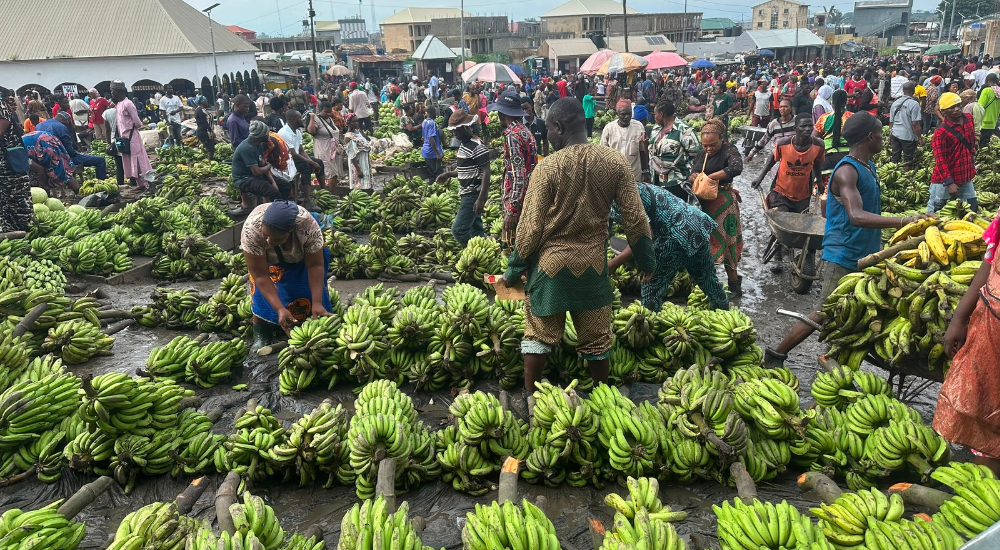
By 6:30 a.m., the Zuba Fruits Market comes alive, not with the arrival of trucks, but with the first bargain of the day.
The fruits are already there.
Every bunch of plantain (arranged in dozens), watermelons, a crate of pineapple, a basket of oranges and a pile of bananas (arranged in sets of three) that would be traded had been delivered and offloaded the previous night. Under the cover of darkness, apprentices work tirelessly to sort the produce into dozens and neatly arrange them for the day’s business.
As dawn breaks over Zuba, a bustling community in the Gwagwalada Area Council that shares a boundary with Madalla in neighbouring Niger State, retailers begin arriving from Abuja and beyond. They walk through the market inspecting the neatly arranged fruits, but no transaction takes place until exactly 6:30 a.m.
Then, almost instantly, the atmosphere changes.
The once calm market erupts into a chorus of bargaining voices. Buyers negotiate prices. Wheelbarrow pushers position themselves to move purchases. Registered dealers dart from one customer to another, striking deals in quick succession as hundreds of transactions begin simultaneously.
To the untrained eye, the men negotiating prices appear to own the towering heaps of fruits spread across the market. But they do not!
Most of them are commission agents, registered dealers informally known as Lali, who neither cultivate the farms nor own the produce they sell. Instead, they act as intermediaries between farmers or suppliers and retailers, earning a commission known as ‘Ladda.’ This practice has quietly sustained livelihoods in one of the Federal Capital Territory’s busiest fruit markets for decades.
It is a business model in which trust is the currency, reputation is the capital, and relationships determine who prospers.
According to a Gwagwalada Council official who did not want his name disclosed, the market remits about N5.5m monthly to the local government, although the exact figure depends on assessments by the market’s consultancy management.
The revenue is generated through ‘tax’ on every truck or van bringing produce into the market. Every truck pays N10,000 each, with as many as 50 trucks and vans entering the market on a busy day.
The market currently has about 360 registered dealers, each working with an average of 20 apprentices, creating thousands of direct and indirect jobs. To be registered as a dealer in the market, a fee of N200,000 is charged, an indication of the volume of business generated in the market.
For Jimoh, one of the market’s registered dealers, every trading day begins long before the market officially opens.
While buyers are still on their way to Zuba, he and his team alongside other traders have already completed hours of work.
Around him are about 15 apprentices, each assigned a role in preparing the produce for sale. Throughout the night, they arrange bunches of plantains into dozens according to size, ensuring the fruits are ready before the first retailer arrives.
“We are agents to our suppliers,” Jimoh told THE WHISTLER. “When they supply us the goods, we help them to make sales and after sales, we don’t collect anything from them. We make our money from the tax we add for the customer.”
Jimoh has about 15 other boys working with him alone. It’s the boys that are in charge of arranging the plantain in dozens of sizes ahead of sales. And it is done overnight.
Unlike conventional traders, Jimoh does not buy the fruits he sells. Instead, farmers and suppliers from different parts of the country consign their produce to him, trusting that he will find buyers, negotiate favourable prices and remit the proceeds after every sale.
His responsibility, he explained, is to ensure the owners do not suffer losses.
“When they supply us, our own responsibility is for us to sell it for them to their satisfaction. So as not to record losses. We are not paid remuneration by the suppliers, but from the buyers.”
That payment is what gives the business its identity.
Known in the market as Ladda, it is a 10 per cent commission paid by retailers after every successful transaction.
“Now when we sell to traders at Zuba, they pay us 10 per cent of the total sum. So, for every N1,000 we are paid N100. That fee is called ‘Ladda’,” Jimoh explained.
The commission does not come from the supplier’s earnings. Rather, it is added to the total cost paid by the retailer. If produce worth N4m is sold, the supplier receives the full value of the goods, while the buyer pays an additional 10 per cent commission to the agent.
“So, if we make roughly N4m from a supply of J5 van, our profit is N400,000 and when sales are good or during scarcity, I sell about two vans at a higher cost.”



Enugu Monarch Faces ₦2bn Lawsuit Over Alleged Unlawful Detention

International Energy Insurance Slumps 26.6% to Lead Weekly Losers

How investors can legally reduce tax they pay on investments

2027: Why opposition parties should unite behind single presidential candidate – Lukman

2027: Makinde appoints Ehilebo as special adviser on media

Nigerians Divided as Pastor Kingsley Okonkwo Launches ₦700,000 VIP Marriage Platform

SERAP, NGE raise the alarm over N20m foreign aid bill penalty

Trans-Sahara highway: Minister gives fresh orders to save buildings, others
-

 Breaking3 days ago
Enugu Monarch Faces ₦2bn Lawsuit Over Alleged Unlawful Detention
- Finance2 days ago
International Energy Insurance Slumps 26.6% to Lead Weekly Losers
- Business2 days ago
How investors can legally reduce tax they pay on investments
- Politics2 days ago
2027: Why opposition parties should unite behind single presidential candidate – Lukman


