News
How rising fuel imports is forcing export focus despite strong local supply capacity – Dangote Refinery

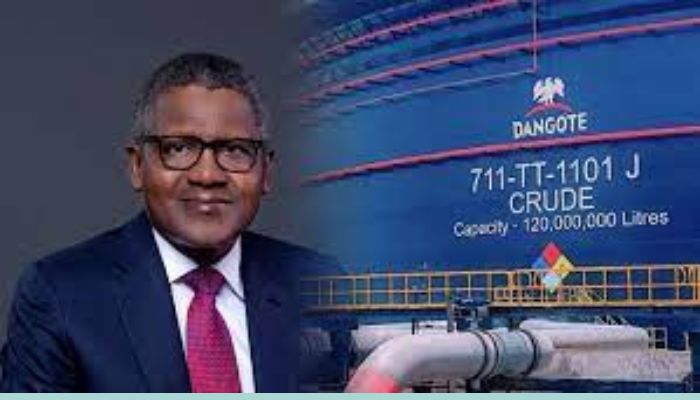
The management of Dangote Petroleum Refinery and Petrochemicals (DPRP) Wednesday expressed concern over the continued issuance of petroleum product import licences despite the its proven capacity to meet and surpass Nigeria’s domestic Premium Motor Spirit (PMS) requirements.
The refinery noted that while it remains fully committed to supporting Nigeria’s energy security and ensuring uninterrupted fuel availability across the country, the volume of imported PMS entering the market has created uncertainty in domestic demand planning and inventory management.
According to market data available to the refinery, imported PMS accounted for approximately 43 per cent of the fuel supplied into the Nigerian market in July, a development that raises questions about the necessity of continued large-scale imports when substantial local refining capacity exists.
Since commencing operations, Dangote Refinery has consistently maintained sufficient inventory levels and reserved product volumes to guarantee steady supply to the Nigerian market. This commitment has required significant investment in storage, logistics, and working capital, all aimed at protecting Nigerians from supply disruptions and market volatility.
However, the refinery stated that the absence of transparency regarding the actual volume of imported products expected into the country makes effective production and inventory planning increasingly challenging. Maintaining large stock positions without clear visibility into import volumes imposes substantial carrying costs on the refinery and ultimately undermines efficient market operations.
The organization said: “As a responsible energy provider, we have always endeavoured to keep adequate reserves to satisfy local demand at all times. However, in an environment where significant volumes of imported PMS continue to enter the market through licences issued by the regulator, and where there is limited visibility on future import volumes, it becomes commercially unsustainable to continue holding excess inventory indefinitely.”
The refinery explained that, under these circumstances, any surplus products not immediately absorbed by the domestic market must be exported to regional and international markets.
Consequently, DPRP’s export volumes have increased in recent months, not because local demand cannot be met, but because excess inventory generated by market uncertainty must be evacuated to avoid unnecessary storage and financing costs.



Zenith Bank Charts New Path to Scale Nigeria’s $6.1bn Non-Oil Export Market

Ogun 2027: ‘APC can’t suspend me after taking N50m’ – Hunye

ADC challenges Tinubu to clarify ‘all is fair in politics’ remark

Oluwo urges Tinubu to grant Nnamdi Kanu presidential amnesty

MTN Nigeria emerges as key driver of Group’s first half 2026 growth

FG targeting 6,500MW of power supply by December, says Tegbe

You lied – TCN tells AEDC as organizations clash over conflicting claim on Abuja power shortage

‘Win With Tinubu’ team to meet Ododo, targets 239 wards in Kogi
-

 Finance3 days ago
Zenith Bank Charts New Path to Scale Nigeria’s $6.1bn Non-Oil Export Market
- Politics3 days ago
Ogun 2027: ‘APC can’t suspend me after taking N50m’ – Hunye
- Politics2 days ago
ADC challenges Tinubu to clarify ‘all is fair in politics’ remark
- News2 days ago
Oluwo urges Tinubu to grant Nnamdi Kanu presidential amnesty