Society
How NASS Used Five Colleges As Conduits For N565bn Constituency Projects

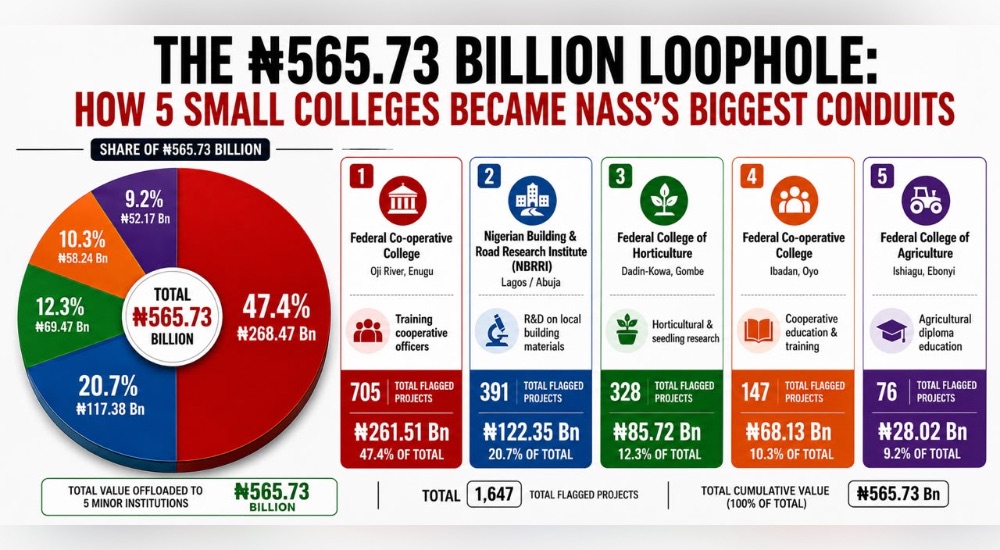
…1,647 Projects Parked Under Institutions With Limited Statutory Mandates
…Roads, Erosion Control, Hospital Solar Schemes Routed Through Academic Institutions
An exclusive data-driven analysis of the 2026 Appropriation Act by THE WHISTLER has uncovered a massive budget-offloading scheme whereby five relatively small academic institutions and research centres were allocated a combined N565.73bn for projects that bear little or no relationship to their statutory mandates.
By analysing all 95,630 line items contained in the 2,604-page 2026 Appropriation Act, THE WHISTLER found that the institutions, which ordinarily exist to train students, conduct research and provide specialised education, have instead become major channels for constituency projects ranging from erosion control and road construction to hospital electrification, solar streetlights and empowerment programmes.
The investigation identified 1,647 flagged capital projects routed through the five institutions.
The largest beneficiary is the Federal Co-operative College, Oji River, Enugu State, which alone accounts for 705 projects worth N261.52bn. Established primarily to train cooperative officers and promote cooperative education, the college received almost half of the total value of all flagged projects.
Next is the Nigerian Building and Road Research Institute (NBRRI) with 391 projects valued at N122.35bn. Although the institute’s mandate is to conduct research into indigenous building materials and road technologies, the volume and nature of projects assigned to it extend far beyond research activities.
The Federal College of Horticulture, Dadin-Kowa, Gombe State, followed with 328 projects worth N85.72bn despite its statutory responsibility being limited to horticultural education, nursery management and crop propagation.
Similarly, the Federal Co-operative College, Ibadan, which focuses on cooperative education and training, was allocated 147 projects valued at N68.13bn, while the Federal College of Agriculture, Ishiagu, Ebonyi State, received 76 projects amounting to N28.02bn.
Combined, the five institutions were assigned projects worth N565.73bn, despite lacking the statutory mandates, engineering capacity or administrative structures expected for executing nationwide civil engineering works and large-scale infrastructure programmes.
The most striking example is the Federal Co-operative College, Oji River (MDA Code: 0215031001).
Designed as a specialised institution for cooperative studies, the college was allocated 705 separate capital projects with a cumulative value of N261.52bn.
A closer examination of page 739 of the Appropriation Act illustrates the scale of unrelated projects clustered under the college’s budget.
Within a single page, the institution was assigned N500m each for erosion control projects in Awgu, Oji River and Aninri Local Government Areas, bringing the total for erosion control to N1.5bn.
In addition, another N400m was earmarked for the installation of solar-powered streetlights across Aninri, Awgu and Oji River, while N400m was allocated for youth entrepreneurship empowerment programmes.
The same page also contains N350m for the provision of mini-grid solar power systems for hospitals, bringing the value of projects listed on that page alone to N2.65bn.
The allocations raise significant questions because erosion control ordinarily falls under agencies responsible for environmental management, while hospital electrification is typically executed by institutions such as the Federal Ministry of Health or the Rural Electrification Agency. Yet these projects appear under the budget of a cooperative college.
Elsewhere in the budget, specifically on page 707, the same institution was assigned two separate N500m allocations for the asphalting of selected farm roads in Udi, Awgu, Oji River and Aninri LGAs, further expanding its portfolio beyond education into heavy civil engineering.
A similar pattern appears in the allocations to the Federal College of Horticulture, Dadin-Kowa, Gombe State (MDA Code: 0215034001).
Although established to provide education and research in horticulture, seedling production and nursery management, the college received 328 projects worth N85.72bn.
Among the projects identified is a N714m road construction project captured on page 790 of the Appropriation Act.
Other allocations include the distribution of vehicles for e-hailing services as well as the construction of prayer halls in commercial centres located far from the institution’s base in Gombe State.
Legal mandates establishing the affected institutions indicate that none was created to execute nationwide infrastructure projects or administer large-scale constituency interventions.
Budget analysts and governance experts who reviewed the findings identified several reasons why lawmakers increasingly route projects through relatively small colleges and specialised agencies.
According to them, mainstream ministries such as Works, Health, Water Resources and Environment generally face stronger procurement oversight and stricter compliance requirements from the Bureau of Public Procurement (BPP), making them less attractive for politically inserted projects.



Strong demand pushes one-year T-bills rate lower to 17.15%

Banking Stocks Continue to Dominate NGX Despite Market Decline

Four children held captive in truck for 7 years by woman and her fiancé
âMake una help me o. Yahoo boys no go k!ll person for Ekpoma- Woman shouts after car rammed directly into her shop in Edo state

Dangote Refinery Raises Petrol Price To N1,200 Per Litre

First HoldCo Trading Hits N11 Billion as Institutional Demand Intensifies

Civilian president can behave like dictator – Falana

MAN seeks safeguards for manufacturers under new tax law
-

 Business3 days ago
Strong demand pushes one-year T-bills rate lower to 17.15%
- Finance2 days ago
Banking Stocks Continue to Dominate NGX Despite Market Decline
- Special Reports2 days ago
Four children held captive in truck for 7 years by woman and her fiancé
- Special Reports2 days ago
âMake una help me o. Yahoo boys no go k!ll person for Ekpoma- Woman shouts after car rammed directly into her shop in Edo state