News
CBN, finance ministry sign MoU to formalise fiscal, monetary coordination

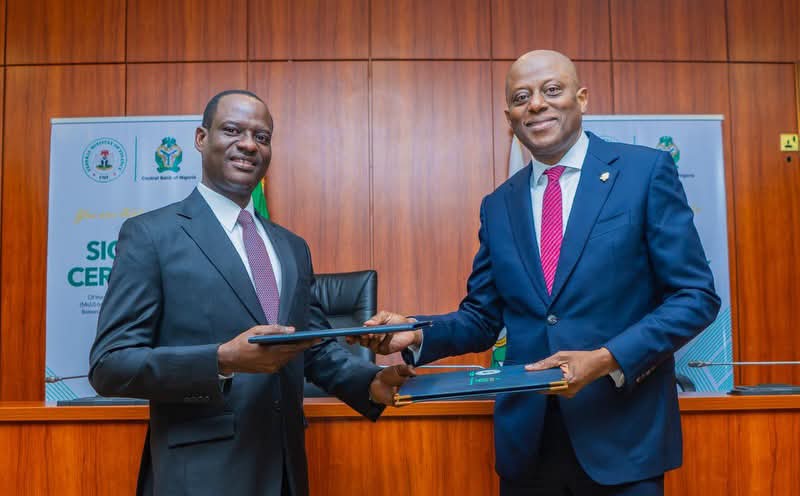

The Central Bank of Nigeria (CBN) and the Federal Ministry of Finance recently signed a Memorandum of Understanding (MoU) aimed at institutionalising coordination between the country’s fiscal and monetary authorities, in a move officials say will strengthen macroeconomic management and support Nigeria’s transition to an inflation-targeting framework.
Since President Bola Ahmed Tinubu assumed office in 2023, Nigeria’s economy has witnessed several challenges which have really put those managing the economic and financial affairs on their toes.
However, no stone has been left unturned in evolving macroeconomic strategies to tackle such challenges.
One of such strategies was the signing of a memorandum of understanding (MoU) on September 18, 2026, by the CBN Governor, Olayemi Cardoso and the Minister of Finance and Coordinating Minister of the Economy, Professor Taiwo Oyedele.
Both officials described the agreement not as the creation of a new relationship between the two institutions, but as the formalisation of a longstanding partnership that has guided Nigeria’s response to inflation, debt sustainability, budget financing and exchange rate management for decades.
A framework for regular consultation
In his remarks, Cardoso said fiscal and monetary policy are complementary tools for managing a modern economy with fiscal policy operating through government spending, taxation and borrowing, and monetary policy working through liquidity management, interest rates and financial system oversight.
He argued that when the two are properly aligned, their combined effect on the economy exceeds what either can achieve alone.
The governor explained that the MoU establishes a structured system for regular consultation, information sharing and policy coordination between the two institutions. Areas of focus will include government cash management, debt issuance planning, liquidity forecasting and macroeconomic analysis.
He said the framework is designed to convert an informal working relationship into one built on defined processes and institutional commitments, which should reduce uncertainty and improve the quality of economic decision-making.
Cardoso linked the timing of the agreement to the CBN’s ongoing shift toward an inflation-targeting monetary policy framework, noting that internationally, the success of such frameworks depends heavily on the presence of a supportive fiscal environment. He added that the MoU would also serve as the basis for developing a more detailed operational framework to guide implementation going forward.
“One economy, shared outcomes”
For his part, Oyedele framed the agreement around the idea that Nigeria’s fiscal and monetary authorities, despite having separate mandates, are ultimately managing a single economy. He noted that government borrowing decisions affect liquidity and interest rates, that monetary policy in turn affects the government’s own cost of financing, and that exchange rates, tariffs, spending and agricultural policy all interact to shape inflation and revenue outcomes.
Oyedele stressed that the MoU does not create coordination mechanisms from a blank slate. He pointed to existing structures such as the Economic Management Team, the National Economic Council, and legal links between the Ministry and the CBN under the Central Bank Act, which already gives the Ministry and the Office of the Accountant-General a role in the Bank’s governance architecture.
“What the new MoU does is make these existing linkages more deliberate through improved information-sharing, more aligned macroeconomic assumptions, and clearer mechanisms for resolving situations where fiscal and monetary actions may work at cross purposes,” he said.
Importantly, both officials were careful to draw a line between coordination and interference. Oyedele stated plainly that the operational independence of the Central Bank remains untouchable, and that coordination must not be allowed to tip into fiscal dominance over monetary policy. He said, “The CBN would retain full autonomy in pursuing price and financial-system stability, while the government simultaneously strengthens fiscal governance institutions including the Fiscal Responsibility Commission, the Bureau of Public Procurement, the Nigeria Extractive Industries Transparency Initiative (NEITI), the Office of the Auditor-General, and the National Bureau of Statistics.”
Inflation as a “Whole-of-Government” task
A central theme of Oyedele’s remarks was that bringing inflation sustainably into single digits cannot rest on monetary policy alone. He said fiscal policy has its own role to play through disciplined, disinflationary spending, sound cash and liquidity management, and financing approaches that avoid crowding out private-sector borrowing. However, he noted that a significant share of Nigeria’s inflation is structural in nature driven by food costs, imported input costs, energy and logistics areas monetary policy has limited power to influence directly.
On food inflation specifically, the minister called for stronger grain reserves, improved seed varieties and crop yields, expanded irrigation, greater climate resilience in agriculture, and better rural road infrastructure to prevent produce from becoming unaffordable before reaching markets. He said this would require collaboration with state governments, since issues such as unnecessary road levies and farm-access infrastructure often fall outside federal jurisdiction.
On energy, Oyedele said the government’s goal is to maintain price stability without reintroducing fuel subsidies, crediting tax exemptions on fuel and improved foreign exchange stability with helping to moderate prices so far. He warned that returning to a subsidy regime would risk fiscal collapse, place pressure on the naira, and ultimately undermine the very affordability it would be intended to protect.
Better data for better policy
Both officials emphasised the importance of improved data quality as monetary policy shifts toward an inflation-targeting model. Oyedele said the Ministry is working with the National Bureau of Statistics to expand the range of economic indicators available to policymakers, including a producer price index to complement the existing consumer price index, along with employment and productivity data.
He said this data would help authorities detect inflationary pressure before it reaches consumers, and allow growth to be judged by whether it generates real jobs rather than by GDP figures alone. He added that the Ministry and the CBN would also begin sharing data more efficiently on cash positions, financing plans, credit growth and foreign exchange flows.
Market confidence and investment signals
Oyedele pointed to a series of recent economic indicators as evidence that market confidence in Nigeria’s reform trajectory is returning. He cited a balance-of-payments surplus of more than five billion dollars recorded in 2025, external reserves that have recently exceeded fifty-four billion dollars, and a milestone in the third quarter of 2026 in which non-oil exports outpaced oil exports for the first time. He also noted a decline in refined-product imports as domestic refining capacity has expanded.
On the international front, the Minister noted that FTSE Russell has confirmed Nigeria’s return to Frontier Market status effective September 21, 2026, and that JPMorgan announced this week that Nigeria will be included in its new frontier local-currency government bond index.
Despite these gains, he cautioned against complacency, saying the government’s ambition extends beyond attracting portfolio investment to securing “patient capital” long-term foreign direct investment that translates into factories, infrastructure, technology and jobs. He argued that capital follows trust before it follows returns, which is why policy consistency and clarity remain essential, including through the newly established Finance Bill process for legislative changes.
He also flagged the risk of regulatory overreach, warning that a series of individually reasonable rules can accumulate into an excessive burden on businesses. He further linked economic performance to non-conventional policy areas, arguing that insecurity and illicit financial flows carry real economic costs that require financial intelligence and economic inclusion strategies rather than security measures alone.
Complementary, not competing, mandates
Both officials closed on a similar note. Cardoso used the occasion to thank Oyedele for his commitment to sound economic governance and credited the technical teams of both institutions for the work behind the agreement. He reaffirmed the CBN’s commitment to sound monetary policy, macroeconomic stability and financial system resilience.
Oyedele summarised the philosophy underpinning the MoU by describing fiscal and monetary policy as two engines that have historically sometimes pulled in different directions, and expressing hope that the new framework would help them function as one.
He said the Ministry would contribute fiscal discipline, improved liquidity management, stronger data and transparency, and structural reforms carried out in partnership with state governments, while the CBN continues to exercise its mandate independently.
The signing comes as Nigeria pursues a broader set of macroeconomic reforms aimed at taming inflation, stabilising the naira, and rebuilding investor confidence following recent years of economic volatility.



BBNaija S11: Yusuf, Chimsom Chuka evicted from reality show

NDLEA officer drowns while chasing drug suspect into Delta river

CBN Faces Rate-Cut Decision as Inflation Falls to 15.39%, Reserves Top $54bn

37 miners’ death: I’m just chief security officer by mouth – Gov Bago

Miners’ death: Gold can be found on streets after heavy rainfall in Niger – Bago

22-year-old allegedly st@bs another to d3ath in Bauchi

âThis is pure nonsense. US didnât arrest Gaddafi, Castro, Ayatollah Khomeiniâ â Tinubuâs aide defends his absence from UN General Assembly

HURIWA hails AGF, EFCC for efforts to protect Nigeria from crippling financial liabilities
-

 Breaking3 days ago
BBNaija S11: Yusuf, Chimsom Chuka evicted from reality show
- Special Reports3 days ago
NDLEA officer drowns while chasing drug suspect into Delta river
- Finance3 days ago
CBN Faces Rate-Cut Decision as Inflation Falls to 15.39%, Reserves Top $54bn
- Breaking3 days ago
37 miners’ death: I’m just chief security officer by mouth – Gov Bago