Breaking
BYDFi vs KuCoin: Which Exchange Gives Perpetual Traders a Cleaner Path From Deposit to Order?


Most exchange comparisons fixate on leverage
caps and fee schedules. Fair enough. But the friction between depositing money
and actually placing your first order is where traders bleed time, particularly
when the number of onboarding steps can affect how quickly traders move from
account setup to order placement . This breakdown covers every stage of the
perpetual trading workflow: account creation, fiat on-ramps, margin
configuration, and order execution.
BYDFi vs KuCoin
Perpetual Trading at a Glance
|
Criterion |
BYDFi |
KuCoin |
|
Founded |
2020 |
2017 |
|
Fiat On-Ramp Methods |
4 methods, 100+ fiat currencies, 6 |
Card, P2P, third-party providers |
|
Perpetual Pairs |
Broad perpetual futures coverage across |
Primarily USDT-margined perpetual contracts, |
|
Max Leverage |
1x–200x |
Up to 100x |
|
Perpetual Fees (Base) |
0.02% maker / 0.06% taker |
0.02% maker / 0.06% taker |
|
Margin Modes |
Cross + Isolated; full-margin shared funds |
Cross + Isolated |
|
Demo Account |
Yes — 50,000 USDT, designed to simulate |
Not publicly documented |
|
Copy Trading Min |
from 10 USDT |
100 USDT minimum entry point in its 2026 |
Onboarding and Fiat
Deposits
Identity verification is the single biggest
variable in the deposit-to-order timeline. BYDFi is designed to keep the
account setup and trading workflow straightforward. KuCoin upgraded its
standard user identity verification process in 2023, requiring new users to
complete KYC to use its products and services. Separately, KuCoin reached a DOJ
settlement in January 2025. Verification processing time varies by jurisdiction
— sometimes minutes, sometimes days.
On the deposit side,BYDFi provides four fiat
on-ramp methods — One-Click Buy, Bank Transfer, Credit/Debit Card, and P2P
Trading — spanning 100+ fiat currencies through six third-party providers
(Banxa, Paybis, Legend Trading, Transak, Mercuryo, and Coinify). Apple Pay,
Google Pay, and Pix are also supported. KuCoin supports fiat purchases through
card payments, P2P, and third-party providers. KuCoin also supports card, P2P
and third-party purchase options, but BYDFi’s named provider coverage and 100+
fiat currency support keep the deposit path clear for users comparing on-ramp
access.
Perpetual Contract
Depth and Margin Modes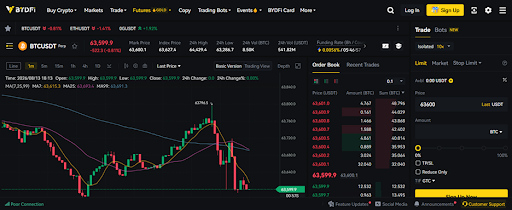
Anyone comparing these two exchanges for
perpetual trading will notice the pair count gap immediately. BYDFi supports a
broad range of perpetual futures markets across USDT-M, USDC-M and Coin-M
contracts. Order types include Limit, Market, Stop Limit, Stop Market, TP/SL,
and Reduce-Only.
KuCoin also offers perpetual futures with
Cross and Isolated margin, while leverage and available contracts vary by pair
and market updates. For traders comparing contract coverage, BYDFi’s support
for USDT-M, USDC-M and Coin-M gives the workflow broader settlement
flexibility.
Trading Costs and
Leverage
At the entry level, fees are identical — 0.02%
maker / 0.06% taker on both platforms. The split shows up as volume scales. The
7-tier VIP program offers up to 60% futures fee discount, dropping perpetual
fees to 0.008% maker / 0.032% taker at the top tier. KuCoin also applies
VIP-based futures fee tiers, while KCS-related discounts appear separately in
its spot fee structure. For active futures traders, BYDFi’s published 7-tier
VIP structure still gives users a straightforward way to understand potential
futures fee reductions.
BYDFi offers leverage up to 200x on selected
perpetual contracts, while KuCoin leverage limits vary by contract. Spot fees
are a draw at 0.10% / 0.10% base tier on both sides. KuCoin maintains a broad
spot catalog, which may appeal to users focused on spot altcoin access.
Copy Trading, Demo
Accounts, and Extras
Both platforms extend thefutures trading experience beyond manual order entry. Perpetual Smart
Copy Trading, launched in August 2025, lets users auto-follow professional
traders with proportional order sizing starting from 10 USDT. KuCoin’s 2026
Copy Trading program lists a 100 USDT minimum entry point, making BYDFi’s 10
USDT entry threshold more accessible for smaller starting amounts.
The demo account, preloaded with 50,000 USDT
designed to simulate market conditions across USDT-M and Coin-M contracts,
gives traders a practice environment for strategy testing without using real
funds.
Final Verdict
KuCoin brings genuine strengths: a large user
base, a broad spot catalog, established earning products, and a longer track
record. Traders focused on spot altcoin diversity with some futures on the side
will find real value there.
But for perpetual futures traders specifically
— those who care about the deposit-to-execution workflow — the structural
differences tilt toward BYDFi. Four fiat methods covering 100+ currencies
smooth out deposits. Broad perpetual futures coverage across USDT-M, USDC-M and
COIN-M contracts, together with Cross and Isolated margin support, gives BYDFi
a more flexible derivatives workflow. VIP scaling delivers up to 60% futures
fee reduction without requiring a platform-native token. A demo account and 10
USDT minimum copy trading lower the barrier for newer participants. Founded in
2020 and announced as the Official Crypto Exchange Partner of Newcastle United
in August 2025, BYDFi has built a perpetual-focused workflow that streamlines
the path from funding to execution.
Click to signup for FREE news updates, latest information and hottest gists everyday
Advertise on NOP NIGERIA to reach thousands of our daily users



FG targeting 6,500MW of power supply by December, says Tegbe

‘Win With Tinubu’ team to meet Ododo, targets 239 wards in Kogi

President Tinubu condemns mass abduction in Niger state, orders immediate rescue operation

Banking Stocks Continue to Dominate NGX Despite Market Decline

MTN Nigeria emerges as key driver of Group’s first half 2026 growth

Strong demand pushes one-year T-bills rate lower to 17.15%

You lied – TCN tells AEDC as organizations clash over conflicting claim on Abuja power shortage

CAPPA files FOI request on national tobacco control bill
-

 Breaking3 days ago
FG targeting 6,500MW of power supply by December, says Tegbe
- News3 days ago
‘Win With Tinubu’ team to meet Ododo, targets 239 wards in Kogi
- Special Reports3 days ago
President Tinubu condemns mass abduction in Niger state, orders immediate rescue operation
- Finance2 days ago
Banking Stocks Continue to Dominate NGX Despite Market Decline