Politics
Bode George Writes NJC, Raises Concern Over PDP Leadership Judgment

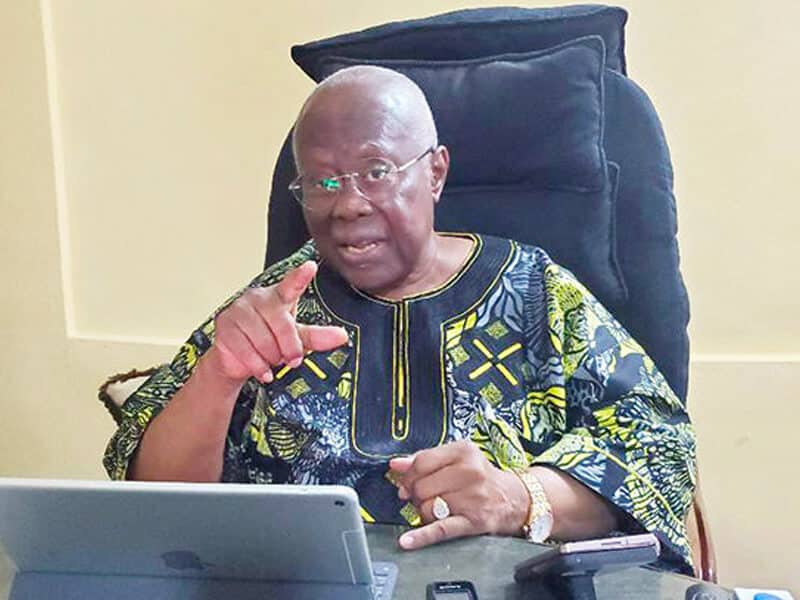
A former Deputy National Chairman of the Peoples Democratic Party (PDP), Bode George, has appealed to the National Judicial Council (NJC) to safeguard the independence, integrity and credibility of the Nigerian judiciary amid concerns over a recent judgment connected to the leadership crisis in the opposition party.
George, in an open letter addressed to the Chairman of the NJC on Friday, said developments surrounding the case had raised questions about public confidence in the justice system and the responsibility of the courts in protecting constitutional democracy.
The PDP Board of Trustees member said the case was instituted by the party’s BoT chairman and other members seeking to compel the Independent National Electoral Commission (INEC) to implement existing court judgments and update its records to recognise the PDP leadership headed by Kabiru Tanimu Turaki (SAN).
According to George, the action relied on subsisting judgments of the Supreme Court, Court of Appeal and Federal High Court.
He, however, expressed concern that the court dismissed the suit as a waste of judicial time without, in his view, sufficiently addressing the constitutional questions raised by the applicants.
The court also awarded ₦140 million in costs against the PDP Board of Trustees and another N10m against its counsel.
George, in the letter titled, The Imperative of preserving the sanctity, independence and integrity of the Nigerian judiciary, insisted that the issues placed before the court deserved substantive consideration.
He said, “The matter before the Court was far from frivolous. It arose from an action instituted by the Chairman and members of the Board of Trustees of the Peoples Democratic Party.
“The action sought to compel the Independent National Electoral Commission (INEC) to comply with and give effect to subsisting judgments of the Supreme Court, the Court of Appeal and the Federal High Court by updating its official portal to reflect the authentic faction of the Peoples Democratic Party as led by Mr Kabiru Tanimu Turaki, SAN, recognised by the judgments, rather than continuing to recognise the Wike-led faction.
“Instead of first determining the substantive constitutional questions before it including whether INEC was under a legal obligation to comply with those subsisting judgments and amend its official records accordingly, the Court dismissed the action as a waste of judicial time and proceeded to award costs of N140 million against the Board of Trustees and a further N10 million against counsel.”
George argued that the controversy went beyond the PDP’s internal leadership struggle and raised wider questions about adherence to court judgments, constitutional governance and the rule of law.
George Tackles Wike-Led Faction
The former PDP national officer also criticised the reported expulsion of senior party members by the faction associated with the Minister of the Federal Capital Territory, Nyesom Wike.
He questioned the logic behind the development, arguing that senior custodians of the party could not simply be removed in the manner reportedly adopted by the faction.
“It is the greatest joke in the civilised international community today. Morally and ethically, is it possible for a child to expel a father from his house whilst the father is still alive.
“The Wike faction said they have expelled permanent members of the upper echelon of the party, the custodians of the party. What a joke.
“Despite this absurdity, the judge concluded in his judgement that we were wasting the time of the court,” George said.
George further maintained that Nigeria’s constitutional order rested on the hierarchy of courts and obedience to binding judicial decisions.
According to him, judgments delivered by competent courts should remain enforceable unless set aside by a superior court.
“Our constitutional order is founded upon the hierarchy of courts and the binding authority of judicial precedent. Judgments of the Supreme Court are final and binding upon all persons and authorities throughout the Federation.
“Equally, decisions of the Court of Appeal and other superior courts of record are not matters of discretion to be observed or ignored at will. The rule of law demands faithful obedience to subsisting judgments until they are set aside by a court of competent jurisdiction,” he said.
He added that no administrative authority should disregard a valid judgment simply because it disagreed with the outcome.
George said the dispute therefore raised questions that went beyond the political fortunes of any PDP faction.
“The issues raised by this judgment extend far beyond the internal affairs of the Peoples Democratic Party. They go to the very heart of constitutional governance and the administration of justice in Nigeria,” he added.
George Urges NJC Intervention
The PDP chieftain also reminded the NJC of what he described as its constitutional responsibility to preserve the independence, discipline and ethical standards of the Bench.
He said public confidence remained crucial to the legitimacy of the judiciary and warned that perceptions of political interference could weaken trust in the courts.
“The National Judicial Council, established under Paragraph 21 of Part I of the Third Schedule to the Constitution, bears the constitutional responsibility of safeguarding the independence, integrity, discipline, and ethical standards of the Bench.
“That responsibility extends beyond the discipline of judicial officers; it encompasses preserving public confidence in the Judiciary as the impartial guardian of the rule of law,” George said.
He added that the judiciary occupied a central position in a constitutional democracy because citizens depended on the courts whenever disputes arose over the exercise of public power.
“The Judiciary occupies a unique and sacred position in every constitutional democracy. It is the final guardian of the Constitution, the custodian of the rule of law, and the last refuge of every citizen seeking justice,” he said.
George warned that whether justified or otherwise, a public perception that judicial decisions were influenced by political considerations could damage the standing of the courts.
He said, “Whether rightly or wrongly, whenever judicial pronouncements give rise to a reasonable public perception of political influence or constitutional inconsistency, confidence in the administration of justice is gravely diminished.
“Such perceptions, if left unaddressed, threaten not only the reputation of individual courts but the very legitimacy of the Judiciary itself.”
He maintained that Nigerians deserved a judicial system capable of inspiring confidence and upholding the Constitution without fear or favour.
“The Nigerian people deserve a justice system they can trust not one that appears to reward judicial impunity, embolden constitutional abuse, and accelerate the nation’s slide towards institutional collapse,” he said.
George further argued that political interference or perceived judicial recklessness could weaken the rule of law and diminish the moral authority of the courts.
‘Judicial Integrity Not Negotiable’
The PDP elder statesman said the NJC had both constitutional and moral obligations to ensure that the judiciary remained above reproach.
He warned that once citizens lose confidence in the courts, the consequences could affect wider democratic institutions.
“The independence of the Judiciary is not merely a constitutional provision; it is the cornerstone of liberty, the safeguard against executive excess, and the assurance that no citizen is above the law and none is beneath its protection,” he said.
George described the moment as critical for the country’s judicial institutions and urged the NJC to demonstrate that the Bench remained insulated from external influence.
“History will not judge this moment by the silence of those entrusted with the administration of justice, but by whether they rose courageously to defend the Constitution when it mattered most. The integrity of the Judiciary is not negotiable; it is the lifeblood of the Nigerian Republic,” he said.
He consequently called on the NJC to act firmly in defence of judicial ethics, accountability and public confidence.
George added, “I therefore respectfully call upon the National Judicial Council to discharge its constitutional mandate with the courage, impartiality and firmness expected of the guardian of judicial ethics and accountability.
“In doing so, the Council will not only preserve the honour of the Bench but also reaffirm the confidence of the Nigerian people that justice in our country remains blind to political pressure and faithful only to the Constitution and the rule of law.”



FG targeting 6,500MW of power supply by December, says Tegbe

ADC challenges Tinubu to clarify ‘all is fair in politics’ remark

Oluwo urges Tinubu to grant Nnamdi Kanu presidential amnesty

BBNaija: Biggie gives Flora secret mission to make Aikou fall in love

‘Win With Tinubu’ team to meet Ododo, targets 239 wards in Kogi

President Tinubu condemns mass abduction in Niger state, orders immediate rescue operation

MTN Nigeria emerges as key driver of Group’s first half 2026 growth

Troops uncover 3,120 litres of stolen crude, refining equipment in Rivers forest
-

 Breaking3 days ago
FG targeting 6,500MW of power supply by December, says Tegbe
- Politics3 days ago
ADC challenges Tinubu to clarify ‘all is fair in politics’ remark
- News3 days ago
Oluwo urges Tinubu to grant Nnamdi Kanu presidential amnesty
- Breaking3 days ago
BBNaija: Biggie gives Flora secret mission to make Aikou fall in love