Society
Anambra Receives N11.6bn Ecology Funds, Spends N1.18bn As Erosion Swallows Roads, Homes

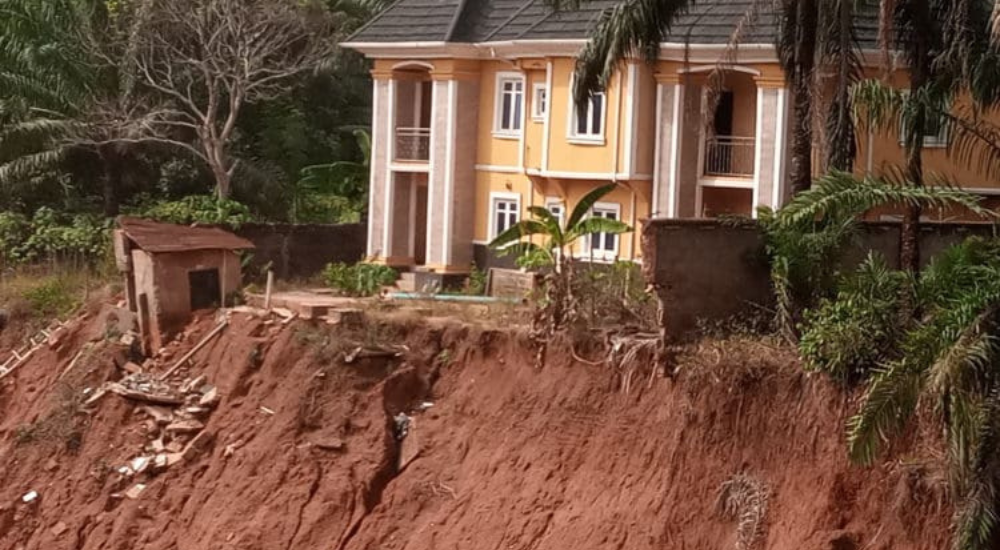
Anambra State and its 21 Local Government Areas (LGAs) received over N11.623bn in ecological fund allocations between 2023 and June 2026, but erosion and flooding continue to destroy roads, houses and farmlands across the state.
The state government received N6.371bn, while its 21 LGAs shared N5.251bn, according to an analysis of monthly Federation Account Allocation Committee (FAAC) records by THE WHISTLER.
Despite the federal allocations, Anambra’s financial records show that only N1.181bn was spent on erosion and flood control between 2023 and June 2026, representing 11.94 per cent of the cumulative N9.890bn appropriated for the purpose during the period.
Anambra, described by Governor Chukwuma Soludo as the nation’s erosion capital, has about 30 per cent of its landmass affected by gully erosion and flooding, attributed to its coarse and friable soil and human factors.
These factors, including waste dumps along drainage routes, structures on waterways and deforestation, have fuelled the state government’s call for self-regulation amid grievances from residents.
However, Soludo’s remarks that the state lacks the financial capacity to completely resolve the perennial problem have also raised questions about how available ecological resources are being deployed.
Between 2023 and June 2026, the Office of the Accountant-General of the Federation (OAGF) distributed cumulative Ecological Fund revenue of N6.371bn to the state government, comprising N1.269bn in 2023, N1.435bn in 2024, N2.290bn in 2025 and N1.377bn in the first half of 2026.
Likewise, a separate distribution to the 21 LGAs stood at N5.251bn, comprising N962.947m in 2023, N1.221bn in 2024, N1.916bn in 2025 and N1.152bn in the first half of 2026.
The allocations increased over the years. While the state’s allocation rose by 13.1 per cent in 2024 and 59.6 per cent in 2025, the LGA allocation increased by 26.8 per cent in 2024 and 57.0 per cent in 2025.
Some discrepancies, however, were identified between FAAC’s published disbursements and the state’s budget and financial records.
An analysis of the Anambra Accountant-General’s Report on the ‘State Share of Ecological Fund From FAAC’ revealed N10.287bn in cumulative Ecological Fund revenue between 2023 and June 2026.
The records listed under the ‘Other Statutory Transfers’ revenue section recognised only the state’s share of the revenue, not that of the LGAs.
THE WHISTLER‘s analysis revealed that while the monthly FAAC distribution records showed over N6.371bn in state Ecological Fund allocations, Anambra recognised N10.287bn in Ecological Fund revenue over the same period.
The state’s recognised revenue comprised N1.167bn in 2023, N4.552bn in 2024, N3.287bn in 2025 and N1.281bn in the first half of 2026.
The analysis showed that the state recorded significantly higher Ecological Fund revenue in 2024 and 2025 than the corresponding FAAC allocations. The cumulative difference stands at N3.916bn.
Notably, the disparity should not automatically be regarded as a surplus in FAAC disbursements or compared on a cash-for-cash basis, as the two sets of records could reflect different accounting periods, adjustments or recognition bases.
THE WHISTLER also identified differences in the state’s reported 2024 figure.
While Anambra’s 2024 Q4 Budget Implementation Report (BIR) recorded N4.253bn in Ecological Fund revenue, the 2025 Accountant-General’s audited statement, published in July 2026, gave the 2024 comparative figure as N4.5519bn.
The difference raises a reconciliation question between the two state records, although the available documents do not, by themselves, establish the reason for the variation.
Beyond federal revenue allocations, there is also a need to evaluate spending on erosion and flood management across the state.
An analysis of Anambra State’s Q4 BIRs and Accountant-General’s reports showed that, out of N32.516bn budgeted as Ecological Fund revenue between 2023 and June 2026, the state’s financial records recognised N10.287bn in Ecological Fund revenue over the same period.
The breakdown showed that the state budgeted N810.280m in 2023, N4.306bn in 2024, N12.399bn in 2025 and N15bn for 2026. Its recorded revenue stood at N1.167bn in 2023, N4.552bn in 2024, N3.287bn in 2025 and N1.281bn in the first half of 2026.
Cumulatively, Anambra recorded 31.64 per cent revenue performance, leaving N22.229bn, or 68.36 per cent of the budgeted Ecological Fund revenue, unrealised during the period.
Further evaluation of Anambra State’s approved budgets and Budget Implementation Reports on Erosion and Flood Control identified a cumulative appropriation of N9.890bn between 2023 and June 2026, with only N1.181bn spent over the period.
A breakdown of the budget and expenditure showed N1.182bn and N348.153m in 2023, N1.375bn and N248.767m in 2024, N2.213bn and N448.182m in 2025, and N5.120bn and N135.705m in the first half of 2026, respectively.



Sokoto: Aliyu will increase NYSC allowance to ₦20,000, donates Hilux to coordinator

Police arrest 5 for defiling minors in Bauchi

Tinubu Banks On Peace In Rivers For 2027 Return

TCN to IKEDC: Stop blaming grid to your blackouts

Attorney who defended convicted Tupac killer ‘Keffe D’ discovered useless

Court remands two Mexicans and 4 Nigerians over Oyo forest meth lab

2027: Jigawa APC inaugurates presidential, governorship marketing campaign council