Society
Otti Backs Mother-Tongue Education, Says Children Learn Better

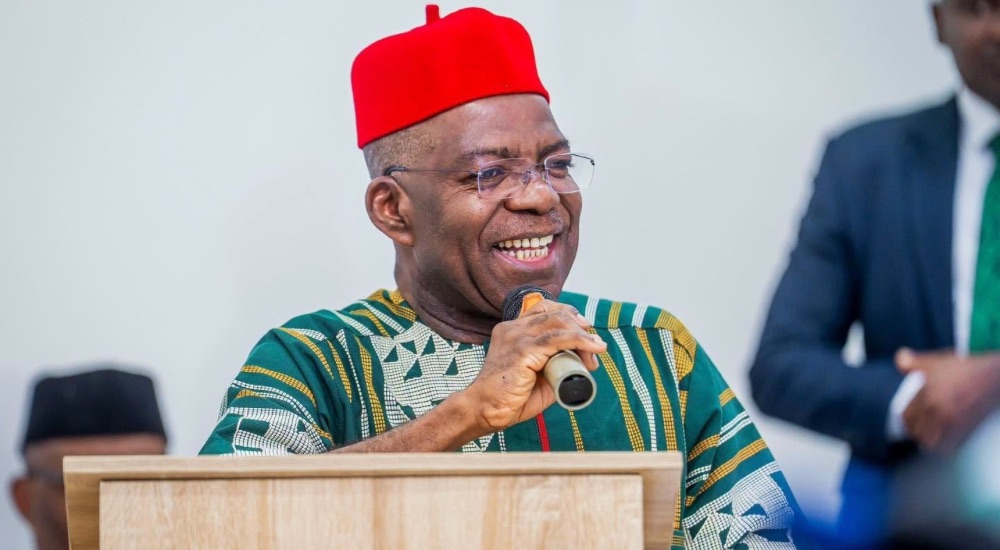
Abia State Governor Alex Otti has backed the use of indigenous languages as the primary language of instruction in early education.
According to him, research has shown that children learn better when taught in their mother tongues.
Otti said Nigeria could examine the limitations of mother-tongue education rather than reject research findings because they challenge existing assumptions about early childhood learning.
The governor spoke on Wednesday at the 24th Annual Lecture/Symposium of the Fafunwa Educational Foundation and the 19th Annual Post-Doctoral Awards in Education at the AGIP Recital Hall, MUSON Centre, Onikan, Lagos.
He said the theme of this year’s event, focused on the relevance of using mother tongues as the primary language of instruction in early education, was relevant to the development of education at the foundational level.
According to Otti, the Fafunwa Educational Foundation has kept alive a research-supported observation made decades ago by the late Professor Aliu Babatunde Fafunwa and others that children learn better when taught in indigenous languages.
“While it is fine to disagree with the findings of a research work, it is, however, not acceptable to reject a viewpoint for the simple reason that agreeing with the facts challenges individual biases and ego,” he said.
“If research says that early learners do better when instructions are passed through the vehicle of indigenous languages, my preference would be to identify and address the probable limitations to teaching pupils in their native languages, including inadequacy of skilled instructors that are fluent in the languages or perhaps, the challenge of limited relevance outside one’s own community or maybe region.”
Otti acknowledged concerns about the practical use of indigenous languages in education, including the availability of teachers fluent in local languages and the question of how useful such languages would be beyond a pupil’s immediate community or region.
He, however, cited South Korea, India and China as countries where early education has been driven by indigenous languages, saying Nigeria could draw lessons from their experience.
He said examining those countries could also provide insight into whether indigenous-language instruction had any relationship with their economic and technological achievements.
“My position would be that if children and professionals in China suffer no disadvantage from learning in Mandarin, just like their counterparts in India or South Korea who started their learning in indigenous languages, then the fears against the use of indigenous languages for early-stage education in this part of the world may be exaggerated at best,” he said.
Otti said he was not sufficiently schooled in language or early childhood learning to make definitive conclusions on the subject, adding that experts at the event would help provide a better understanding of the issue.
He expressed optimism that discussions at the symposium would contribute to policy decisions on education.
The governor also used the occasion to reflect on the legacy of Fafunwa, Nigeria’s first professor of education and a former Minister of Education.
He described Fafunwa as a man of ideas who believed in the capacity of a trained mind to accomplish great things. He said the annual lecture provided an opportunity for intellectuals to examine his contributions to education and reflect on how institutions and policies could produce better outcomes.
The event, the said, had four related purposes: honouring Fafunwa’s legacy, reminding privileged members of society of their responsibility to serve others, questioning existing assumptions and institutions in pursuit of better outcomes, and recognising the enduring importance of scholarship.
He commended the Fafunwa Educational Foundation for keeping the late professor’s memory alive and praised his family, students and protégés for preserving what he described as his legacy of integrity, curiosity and generosity.
The governor also acknowledged the keynote speaker, Professor Francis Egbokhale of the University of Ibadan, guest speaker Professor Angelina Kioko of the United States International University-Africa, and discussants Professor A. A. Adeyinka, Dr Ebele Okafor and Dr Suleiman Aliyu.
He also recognised the presence of Lagos State Commissioner for Basic and Secondary Education, Jamiu Alli-Balogun, who he said could provide perspectives on the gap between policy expectations and administrative constraints.
Otti congratulated the winners of the post-doctoral awards in education and urged them to continue their academic work, saying, “the reward for a good job is more work.”
He also congratulated the writer, Professor Okey Ndibe, on completing Babs Fafunwa: a Mini-Biography for Youngsters, which is a book about the life and legacy of Fafunwa.
Otti said he looked forward to reading the book and sharing it with his children. He added that children in Abia State would be interested in learning about Fafunwa through the work of Ndibe, whom he described as a writer of global renown.



CBN Faces Rate-Cut Decision as Inflation Falls to 15.39%, Reserves Top $54bn

Lagos Govt debunks report of one functional dialysis machine at Alimosho Hospital

âThis is pure nonsense. US didnât arrest Gaddafi, Castro, Ayatollah Khomeiniâ â Tinubuâs aide defends his absence from UN General Assembly

Gombe, Kano, Bauchi, Delta bye-elections offer vital lessons for general election – INEC chairman

JAMB lifts SIM, email change ban, gives candidates fresh directives

NAHCON Sets September 26 Deadline For 2027 Hajj Registration

Nigeria moves to make three years of economic reform durable

Court grants ex-minister Uche Nnaji permission to travel abroad for treatment
-

 Finance3 days ago
CBN Faces Rate-Cut Decision as Inflation Falls to 15.39%, Reserves Top $54bn
- Breaking2 days ago
Lagos Govt debunks report of one functional dialysis machine at Alimosho Hospital
- Special Reports3 days ago
âThis is pure nonsense. US didnât arrest Gaddafi, Castro, Ayatollah Khomeiniâ â Tinubuâs aide defends his absence from UN General Assembly
- Politics3 days ago
Gombe, Kano, Bauchi, Delta bye-elections offer vital lessons for general election – INEC chairman