World News
Operation 'Crimea-Cutoff': How Ukraine Is Isolating Russia's Stronghold By Air, Land And Sea


Ukraine’s expanding drone campaign is reshaping the battlefield in the Russia-Ukraine war by steadily isolating Crimea from mainland Russia.
For more than a decade, Crimea has remained the symbolic centrepiece of Vladimir Putin’s Russia. Annexed in 2014 and presented by the Kremlin as an irreversible territorial gain, the peninsula has served both as a strategic military base and a political symbol of Russian resurgence. Today, however, Ukraine’s expanding drone campaign is steadily transforming Crimea from one of Moscow’s greatest prizes into one of its biggest operational challenges.
Rather than launching a conventional assault, Kyiv has adopted a strategy designed to isolate Crimea piece by piece. Ukrainian forces have struck bridges, railway links, fuel infrastructure, ports, air-defence positions and logistics hubs connecting the peninsula to mainland Russia. The objective is to complicate Russian military operations in southern Ukraine while steadily raising the economic and logistical cost of holding Crimea.
According to Ukrainian officials, recent strikes have damaged dozens of energy facilities while repeated attacks have targeted key transport arteries, including the Chonhar Bridge, the Henichesk crossing and sections of the R-280 Novorossiya highway. Satellite imagery has also indicated damage around Kerch port, an important logistics node supporting Russian operations.
The disruption has increasingly spilled into civilian life. Reports indicate widespread fuel shortages, electricity blackouts, water restrictions and mass cancellations across Crimea’s tourism sector, while queues at fuel stations and transport checkpoints have become increasingly common.
Ukrainian Defence Minister Mykhailo Fedorov has argued that the campaign is gradually turning Crimea into an isolated military outpost rather than the secure rear area Russia once envisioned.
Military analysts say the campaign reflects a broader shift in modern warfare. Ukraine has rapidly expanded its use of affordable mid-range drones equipped with AI-assisted terminal guidance, Starlink connectivity and autonomous targeting systems capable of operating despite Russian electronic warfare measures. Officials and defence developers argue these systems have significantly narrowed the operational gap between frontline attacks and deep strikes inside Russian-held territory.
Analysts quoted by The Telegraph say sustained attacks on logistics networks are beginning to affect Russia’s operational flexibility, reducing artillery advantages and complicating the movement of ammunition and fuel to frontline units. Ukrainian President Volodymyr Zelenskyy has similarly argued that control of the air domain will increasingly determine the outcome of the Russia-Ukraine war, while developers caution that the technological advantage may narrow as Russia adapts with new counter-drone capabilities.
Even so, Kyiv’s campaign against Crimea has become one of the most consequential operational developments of 2026, signalling that future battles may be decided as much by logistics and autonomous systems as by conventional ground offensives.








Strong demand pushes one-year T-bills rate lower to 17.15%

You lied – TCN tells AEDC as organizations clash over conflicting claim on Abuja power shortage

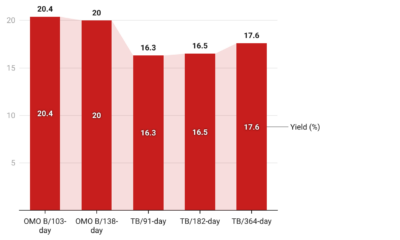
CBN’s OMO reopening tests the price of government domestic borrowing

CAPPA files FOI request on national tobacco control bill

Banking Stocks Continue to Dominate NGX Despite Market Decline

Four children held captive in truck for 7 years by woman and her fiancé
âMake una help me o. Yahoo boys no go k!ll person for Ekpoma- Woman shouts after car rammed directly into her shop in Edo state

Dangote Refinery Raises Petrol Price To N1,200 Per Litre
-

 Business3 days ago
Strong demand pushes one-year T-bills rate lower to 17.15%
- Breaking3 days ago
You lied – TCN tells AEDC as organizations clash over conflicting claim on Abuja power shortage
- Business3 days ago
CBN’s OMO reopening tests the price of government domestic borrowing
- News3 days ago
CAPPA files FOI request on national tobacco control bill