News
How Access Holdings trimmed bad-loan fees to spice up revenue



Access Holdings has proven via its current unaudited assertion of account that it’s nonetheless increasing its earnings and reaching for larger heights.
Access Holdings Plc is studying that rising a financial institution and rising its earnings aren’t the identical factor. The group’s unaudited outcomes for the 9 months ended September 30, 2026, present a Pan-African lender nonetheless increasing its earnings, although at a slower tempo and with a special engine from the one which powered earlier quarters.
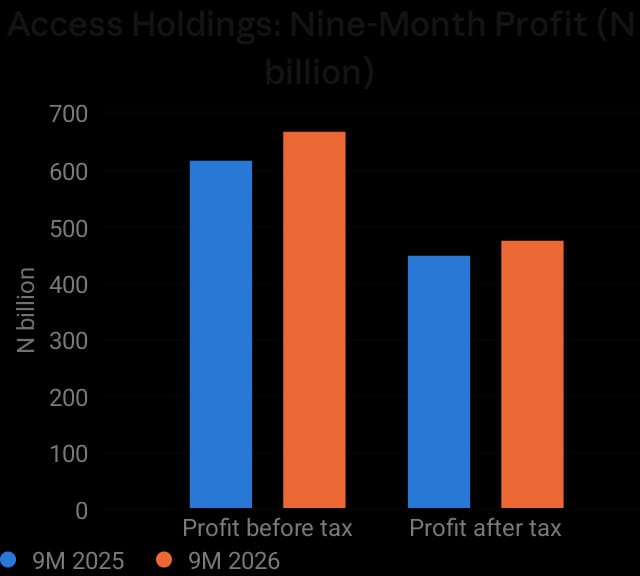
Profit earlier than tax rose 8.3 per cent to N667.4 billion, from N616.2 billion within the corresponding interval of 2025. Profit after tax grew about 5.9 per cent to N474.2 billion, from N447.5 billion. The headline numbers are wholesome. The particulars present how the revenue was made, and the way fragile a few of it could be.
A revenue constructed on decrease provisions
The largest single driver was a pointy fall in impairment fees, the cash banks put aside for loans which will go unhealthy. These dropped to N92.9 billion, a decline of about 73.5 per cent from N349.99 billion a 12 months earlier.
That swing did many of the work. Interest revenue rose 6.9 per cent to N3.1 trillion, however curiosity expense climbed sooner, up about 10.1 per cent to N1.8 trillion from N1.65 trillion. Without the autumn in impairments, the squeeze between what the group earns on property and what it pays for funds would have weighed much more closely on the underside line.
Instead, internet curiosity revenue after impairment grew 32.1 per cent to N1.2 trillion, from N907.95 billion. The group says this was one in every of two vital enhancements within the interval.
The different was charge revenue. Net charge and fee revenue rose 12.4 per cent to N534.9 billion, from N475.92 billion. Fee revenue is the form of recurring income that financial institution managements prize as a result of it relies upon much less on interest-rate cycles and the credit score high quality of the mortgage e-book. Core working revenue, which pulls collectively the group’s major incomes strains, reached N1.83 trillion, up 5.4 per cent from N1.733 trillion.
The different facet of the ledger
The outcomes additionally carry warnings, and the group’s personal commentary acknowledges them.
Operating bills closed at N1.3 trillion, up 11.8 per cent from N1.16 trillion. Costs are rising greater than twice as quick as core working revenue. A financial institution can soak up that for some time when provisions are falling, but it surely can’t accomplish that indefinitely.
Other working revenue additionally fell sharply, down 40.8 per cent to N234.5 billion. The mixed impact was a 3.2 per cent decline in complete working revenue, from N2.13 trillion to N2.06 trillion. In different phrases, the group’s complete revenue really shrank. The revenue enhance got here from spending much less on provisions, not from incomes extra in complete.
None of it is a criticism of the group’s accounts. Analysts quoted within the outcomes materials described the efficiency as extremely constructive and famous that the group is open in regards to the areas needing administration consideration.
The level is that the standard of the development issues as a lot as its dimension. Lower impairments are welcome, however they don’t seem to be a repeatable supply of development. Once provisions settle at a standard degree, revenue development should come from income and price management.
Growth is moderating
The quarterly path suggests momentum has cooled. In the primary quarter, revenue earlier than tax was N272.21 billion, up 22.2 per cent from N222.78 billion a 12 months earlier. By the half-year, the group reported revenue earlier than tax of N414.13 billion, up 29.2 per cent from N320.57 billion. At 9 months, the expansion charge had fallen to eight.3 per cent.
Profit after tax tells an identical story. It grew 18.5 per cent within the first quarter to N216.54 billion, and 23.5 per cent on the half-year to N266.72 billion, in contrast with N215.92 billion. By September, development was right down to about 5.9 per cent.
Part of that moderation displays a more durable comparability base, for the reason that third quarter of 2025 was robust. But it additionally factors to the associated fee and revenue pressures now seen within the outcomes. The first half benefited from the total drive of the impairment discount. The third quarter had much less room for that to repeat.
A group that earns overseas
One of essentially the most putting options of the outcomes is the place the cash is made. Banking remained the principal contributor to group earnings, at 96 per cent of unaudited revenue earlier than tax. Within the banking group, operations exterior Nigeria accounted for 82.2 per cent of revenue earlier than tax.
International banking subsidiaries contributed 43.7 per cent and the Rest of Africa 38.5 per cent. Nigeria, the house market, accounted for simply 17.8 per cent.
For a bunch that started as a Nigerian financial institution, that may be a notable shift. It helps the administration argument that its geographic unfold permits it to deepen buyer relationships throughout commerce finance, transaction banking, funds and treasury companies. It additionally means the group’s fortunes are tied to economies, currencies and regulators properly past Lagos. Diversification reduces dependence on anybody market, but it surely provides publicity to many.
A very giant steadiness sheet
The scale behind these earnings is appreciable. Total property stood at N52.6 trillion at September 30, 2026, up 1.7 per cent from N51.7 trillion on the finish of 2025. Customer deposits grew 6.6 per cent to N36.9 trillion, and loans and advances to prospects rose 7.4 per cent to N14.3 trillion.
Shareholders’ funds had been broadly flat at N4.5 trillion, the identical as on the finish of 2025. Deposits and loans are rising sooner than complete property, which suggests the group is placing its funding to extra direct use in lending. The flat fairness base, although, signifies that development within the steadiness sheet shouldn’t be being matched by development within the capital cushion beneath it.
That is the place the group’s said technique is available in.
What Scale-to-Value means
Management describes its Scale-to-Value agenda as a development from constructing scale to enhancing the standard and productiveness of that scale. The said focus shouldn’t be additional growth for its personal sake, however extracting extra from what has already been assembled, with sustainable shareholder returns as the last word goal.
The framework rests on a number of pillars. Execution capability is about strengthening accountability and turning strategic priorities into measurable outcomes. Risk governance and regulatory compliance centre on sustaining strong management disciplines. Capital self-discipline emphasises productiveness and risk-adjusted returns. Operating effectivity targets value self-discipline and higher use of the group’s infrastructure. Earnings high quality goals to deepen recurring revenue and construct resilience.
Read in opposition to the numbers, the framework is a reasonably direct response to what the outcomes present. The fall in impairments displays danger self-discipline. Fee revenue development speaks to earnings high quality. Rising prices and falling different revenue clarify why effectivity and recurring revenue characteristic so prominently. Management says it can stay centered on moderating expense development, strengthening recurring revenue and enhancing the conversion of income into earnings.
The check shall be whether or not the associated fee line responds. An 11.8 per cent rise in working bills in opposition to a 5.4 per cent rise in core revenue is the hole the technique should shut.
The regulatory hurdle
The most consequential merchandise for shareholders will be the one exterior the revenue assertion. Group Company Secretary Sunday Ekwochi stated in a signed assertion that the group has made important progress in direction of compliance with Section 19(8)(c) of the Banks and Other Financial Institutions Act (BOFIA), which limits a financial institution’s funding in subsidiaries to 10 per cent of shareholders’ funds.
The group has recognized capital recollects from six banking subsidiaries that, as soon as accomplished, are anticipated to deliver the financial institution’s investment-in-subsidiaries ratio inside the threshold. The recall is already full in a single subsidiary, and shareholder approvals have been secured in 4 of the remaining 5. Regulatory approvals are progressing throughout all 5.
The group expects to complete inside the Central Bank of Nigeria’s prescribed timeline. Ekwochi stated completion is predicted to take away the regulatory constraint on dividend distributions.
For buyers, that sentence is the important thing one. Profit development issues little to shareholders if the regulatory restrict prevents the group from paying out. Resolving the subsidiary-investment ratio is due to this fact central to the shareholder-return goal that anchors the Scale-to-Value agenda.
Outlook
Management says it can preserve accelerating execution of the agenda, with priorities that embody stronger execution capability, strong danger governance, disciplined capital allocation, funding optimisation and larger working effectivity. It has promised to maintain strengthening accountability for execution whereas sustaining disciplined danger and compliance requirements.
The said goal is to make sure that the group’s scale is successfully ruled, effectively deployed and persistently translated into sustainable shareholder returns.
The nine-month outcomes present a bunch that has made actual progress on credit score high quality and charge revenue, and that earns most of its revenue exterior its dwelling market. They additionally present prices rising sooner than revenue and complete working revenue slipping.
As the outcomes themselves acknowledge, the sustainability of the development depends upon continued income development, credit score efficiency and price self-discipline. The subsequent few quarters will present whether or not Scale-to-Value is popping into delivered worth.



We’ll not assist you to take over motor parks – Governor Makinde warns NURTW

NAFDAC destroys over 50000 empty branded alcoholic beverage bottles in Lagos

Video of Soludo carrying APGA sash on altar resurfaces after he spoke in opposition to church politics

Three youths arrested over alleged abuse of Kano Hisbah boss

Police arrest girl for hiring hitmen to homicide co-wife’s 14-year-old son in Kano

Opposition Leaders Atiku, Obi, Makinde Set for Another Summit November 23

UK-Backed FSD Africa Moves to Establish $750m Nigerian Pension Infrastructure Fund

Banks’ N55.7trn mortgage e book awaits recapitalisation elevate
-

 Special Reports2 days ago
We’ll not assist you to take over motor parks – Governor Makinde warns NURTW
- Special Reports3 days ago
NAFDAC destroys over 50000 empty branded alcoholic beverage bottles in Lagos
- Special Reports3 days ago
Video of Soludo carrying APGA sash on altar resurfaces after he spoke in opposition to church politics
- Politics3 days ago
Three youths arrested over alleged abuse of Kano Hisbah boss