Society
Higher Revenue, Weak Projects: States Struggle With Capital Budget Execution

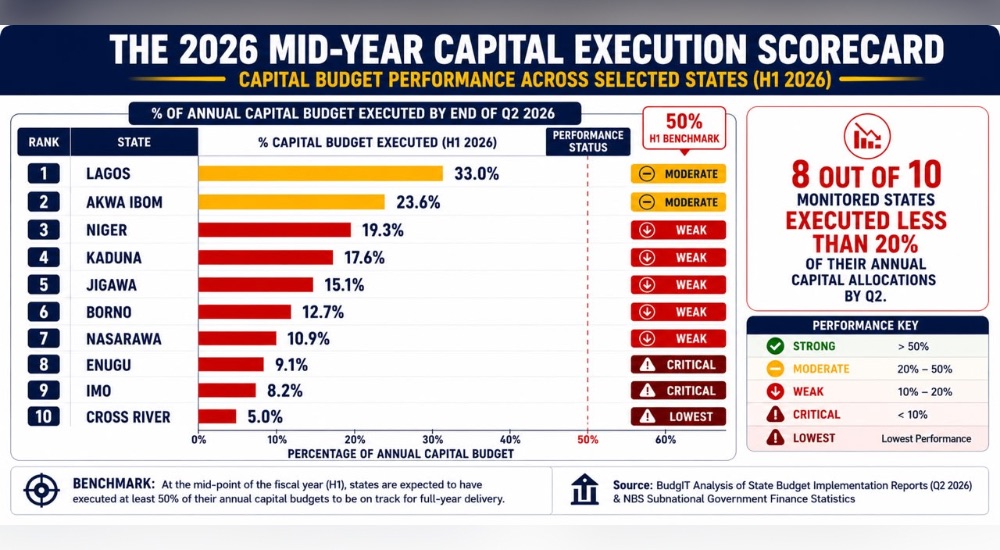
…C/River Records 5% Capital Budget Performance, Imo 8%, Borno 12%
…8 States Execute Less Than 20% Of Capital Budgets
President Bola Tinubu’s claim that Nigeria’s economy is stabilising and public revenues are strengthening is facing a fresh test, as second-quarter budget implementation reports showed that many states are still recording weak capital expenditure despite increased allocations from the Federation Account.
Tinubu had said at an event in July that public revenues were strengthening and state governments were receiving greater allocations, pointing to the fiscal impact of his administration’s economic reforms.
“Our economy is stabilising, no doubt about that. Public revenues are strengthening. State governments are receiving greater allocations right now,” he said.
The increased allocations have also been acknowledged by some state governors. Nasarawa State Governor, Abdullahi Sule, recently said the state’s monthly Federation Account allocation had risen from about N3.8bn-N4.5bn before the reforms to approximately N16bn.
However, the second-quarter budget implementation reports of several states reviewed by THE WHISTLER showed that the increase in nominal revenue has not necessarily translated into commensurate capital spending or overall budget execution.
In Borno State, recurrent revenue stood at N83.62bn in the second quarter, representing 34.1 per cent of the annual budget provision, while capital expenditure amounted to only N44.33bn, representing 12.7 per cent of the 2026 capital budget.
The state attributed the weak capital performance partly to low capital inflows from budgeted sources and the non-realisation of expected funding. It also cited low FAAC allocations and insecurity-related economic constraints.
Imo State recorded an even weaker capital expenditure performance. The state released N101.69bn for capital projects during the second quarter, representing just 8.2 per cent of its N1.24tn annual capital budget. For the first half of the year, cumulative capital releases stood at N167.52bn, or 13.6 per cent of the annual provision.
Imo’s report blamed the low performance partly on contracts undergoing procurement processes, expressing expectations of improved implementation in the following quarter.
In Kaduna, total revenue for the second quarter stood at N108.19bn, while total expenditure reached N139.65bn.
Yet, cumulative capital expenditure at the end of June was N118.82bn, representing only 17.6 per cent of the revised capital budget of N674.37bn.
Niger State recorded N164.37bn in recurrent revenue during the second quarter, equivalent to 27.5 per cent of its annual provision. Its capital expenditure stood at N151.23bn, representing 19.3 per cent of the N783.69bn capital budget.
The state itself described its overall performance as “not impressive”, noting that recurrent revenue and expenditure performance had declined compared with the previous quarter.
Enugu State’s figures also showed a significant gap between revenue inflows and budget implementation. Although the state received N123bn in recurrent revenue during the second quarter, its cumulative recurrent revenue for January to June represented only 17.9 per cent of the original annual budget.
Capital receipts stood at just N23.03bn for the first half of the year, representing 7 per cent of the annual provision, while cumulative capital expenditure reached N118.14bn, equivalent to 9.1 per cent of the original capital budget.
Cross River State reported recurrent revenue of N57.63bn in the second quarter, with cumulative performance at 21.9 per cent of its annual budget. Its mid-year capital expenditure was N33.28bn, representing approximately 5.0 per cent of the total capital budget of N671.27bn.
Jigawa State, meanwhile, recorded cumulative revenue of about N280.71bn by the end of June, representing 31.1 per cent of its annual budget. But its capital expenditure stood at approximately N104.14bn, or 15.1 per cent of the N689.82bn capital budget.
Nasarawa’s total revenue, including opening balance, reached N157.89bn, representing 29 per cent of its annual target. Its recurrent expenditure was N72.57bn, while capital expenditure amounted to only N34.42bn, representing 10.9 per cent of the annual capital allocation.
The state noted that capital implementation remained below the expected mid-year benchmark, suggesting that the pace of project execution was still relatively slow.
Akwa Ibom performed comparatively better, recording N223.06bn in revenue inflows during the second quarter and N386.22bn year-to-date, representing 29.2 per cent of its approved revenue provision.
Its cumulative capital expenditure reached N275.92bn, equivalent to 23.6 per cent of the approved capital budget.
Lagos State recorded the strongest performance among the states reviewed. Its recurrent revenue reached N1.67tn by the end of June, representing 45 per cent of its annual estimate and 90 per cent of its projected half-year revenue.
Cumulative recurrent expenditure stood at N767.15bn, representing 36.4 per cent of the annual budget, while capital expenditure reached N772.64bn, equivalent to 33 per cent of the annual capital budget.



Enugu Monarch Faces ₦2bn Lawsuit Over Alleged Unlawful Detention

International Energy Insurance Slumps 26.6% to Lead Weekly Losers

Nigerians Divided as Pastor Kingsley Okonkwo Launches ₦700,000 VIP Marriage Platform

Trans-Sahara highway: Minister gives fresh orders to save buildings, others

How investors can legally reduce tax they pay on investments

2027: Why opposition parties should unite behind single presidential candidate – Lukman

INEC Denies 2027 Ad-Hoc Staff Recruitment, Warns Against Fake Website

2027: Makinde appoints Ehilebo as special adviser on media
-

 Breaking2 days ago
Enugu Monarch Faces ₦2bn Lawsuit Over Alleged Unlawful Detention
- Finance2 days ago
International Energy Insurance Slumps 26.6% to Lead Weekly Losers
- Breaking2 days ago
Nigerians Divided as Pastor Kingsley Okonkwo Launches ₦700,000 VIP Marriage Platform
- News3 days ago
Trans-Sahara highway: Minister gives fresh orders to save buildings, others


